
corn, (Zea mays)
Zea mays is a large, upright, robust annual grass, usually with a single stem and little branching.
Overview
Zea mays is a large, upright, robust annual grass, usually with a single stem and little branching.
Origin and habitat
Zea mays is native to the Americas; sources differ on its domestication center, with south-central Mexico given as the main account. It is primarily a widely cultivated field crop; cultivated maize is generally not found in a naturally wild state and can adapt to varied environments. It favors a warm to hot, sunny growing season and can be cultivated from temperate regions to lowland tropics.
Characteristics
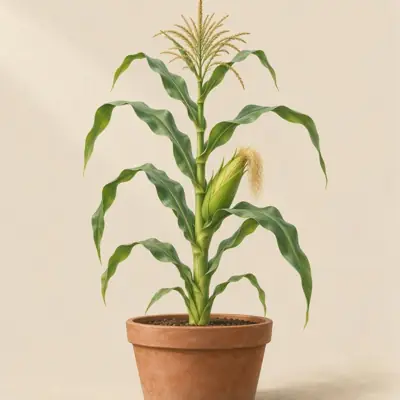
Sources differ on mature height, placing it at about 100–450 cm; mature spread is reported from a single source at about 50–100 cm. It grows rapidly and has alternate, broad, long leaves with a prominent midrib; the leaf bases form sheaths around the stem, and the margins may be wavy. Male and female inflorescences are separate on the same plant: the male inflorescence forms a large panicle at the stem tip, while the female inflorescence develops in a leaf axil, is enclosed by bracts, and bears long, threadlike styles commonly called corn silk; pollination is mainly by wind. Flowering is reported to depend strongly on sowing and cultivation timing, and where continuous cultivation is suitable, different growth stages can result in flowers and fruits being observed throughout the year; the fruit is a caryopsis, with many kernels densely arranged on a thick axis to form an ear, and kernels may be yellow, white, or various other colors.
Light
Zea mays requires full sun.
Watering
It requires ample, consistent moisture during growth, while the soil should remain well drained; avoid watering directly over the plants in ways that interfere with pollination.
Temperature and dormancy
A single source reports an ideal temperature range of about 20–24 °C.
Growing medium and mounting
It grows in fertile, well-drained soil and can grow in loam, clay, sand, and chalky soils; the RHS recommends acidic to neutral conditions.
Feeding
It has high nutrient requirements, especially for nitrogen.
Propagation
Propagation is by seed; sow in a suitable season, and because pollination is wind-mediated, planting in groups or multiple rows favors fuller pollination compared with a single long row.
Common problems
Pests and nematodes that may affect it include European corn borer, corn rootworm, root-knot nematodes, and root-lesion nematodes. Reported common diseases include gray leaf spot, corn ear rot, corn smut, and corn rust. Poor pollination reduces fruit set, while cross-pollination among different maize varieties can also affect kernel quality or sugar content in some sweet maize. It favors warm conditions and has low drought tolerance, requiring ample moisture during the growing season and conditions where the soil has warmed before planting.
Identification
Zea mays can be distinguished by a robust, upright single stem topped by a male inflorescence, female ears enclosed by bracts in the leaf axils, bundles of long threadlike styles extending from the female flowers, and mature ears bearing many kernels exposed beyond the glumes.
Photos


Sources
- Wikipedia (en): Maize — CC BY-SA 4.0 · link
- 維基百科:玉米 — CC BY-SA 4.0 · link
- Wikipedia (ja): トウモロコシ — CC BY-SA 4.0 · link
- Wikipedia (de): Mais — CC BY-SA 4.0 · link
- Wikipedia (fr): Zea mays — CC BY-SA 4.0 · link
- Wikipedia (es): Zea mays — CC BY-SA 4.0 · link
- GBIF descriptions: Manual of the Alien Plants of Belgium; Catálogo florístico de la Faja Petrolífera del Orinoco; The c — per dataset · link
- NC State Plant Toolbox: Zea mays — copyright (facts only) · link
- Useful Tropical/Temperate Plants: Zea mays — CC BY-NC-SA 3.0 (facts only) · link
- RHS Plants: Zea mays — © RHS, facts only · link
- USDA PLANTS Database: Zea mays — Public domain (US Government work) · link