
Wild Grape (Vitis vinifera)
Vitis vinifera is a perennial, deciduous, woody climbing vine or climbing shrub that uses tendrils.
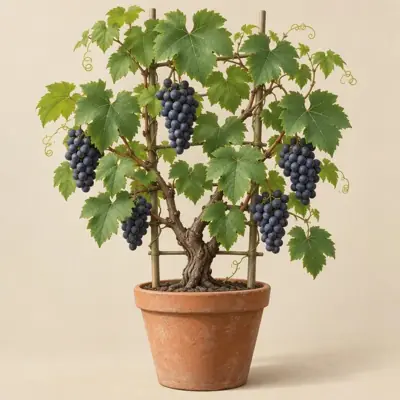
Overview
Vitis vinifera is a perennial, deciduous, woody climbing vine or climbing shrub that uses tendrils.
Origin and habitat
It is native mainly to the Mediterranean region, Central Europe, and southwestern Asia, with its range extending into North Africa, western Asia, and Iran; sources differ somewhat on the precise boundaries. Wild habitats include moist forests and riverbanks, while cultivated plants are widespread in agricultural, horticultural, garden, and park settings. It is reported to be adapted to temperate through subtropical environments, with cultivars also able to grow at higher elevations in tropical regions; growth is considered better where sufficient winter cold allows complete dormancy.
Characteristics
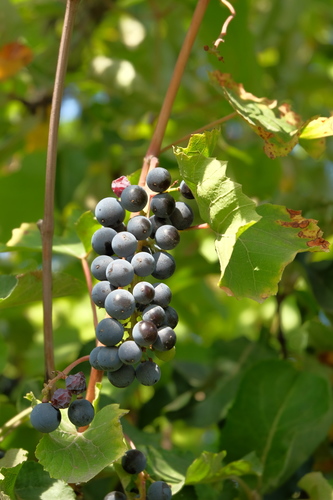
Sources differ on mature height, placing it at about 1500–2000 cm, while limited sourcing reports a mature spread of about 250–400 cm and generally describes growth as fast. Sources describe the alternate leaves as usually lobed, nearly round to heart-shaped or palmate, with coarsely toothed margins, and differ on details including the presence of white down to an almost felted covering beneath. The small green to yellow-green flowers are reported to occur in panicled or compound-panicled inflorescences; cultivated forms generally have bisexual flowers, while wild forms are dioecious. Flowering is reported during part of the year, and sources describe the fruit as oval to spherical berries ranging in color from green, yellow, and red to purple and dark blue-purple, usually containing several seeds.
Light
Vitis vinifera grows in full sun and can grow in partial sun, while fruit ripening favors a warm, sunny, sheltered position.
Watering
Water regularly to moderately, keeping the soil moderately moist but well drained and allowing the surface soil to dry slightly before watering again.
Humidity and airflow
It is generally reported to need good airflow.
Temperature and dormancy
Sources differ on the lower temperature limit, reported at about -20 °C. With limited sourcing, the reported ideal temperature is about 18–30 °C and the reported upper temperature is about 38 °C. Hardiness is described using both USDA and RHS classifications, and the plant is generally reported to be frost hardy.
Growing medium and mounting
Sources differ somewhat on soil conditions: well-drained, humus-rich soil is described, with adaptation to loam, sandy, and calcareous soils and a preference for deep, fertile, moderately moist loam; descriptions of preferred soil reaction range from acidic-to-neutral conditions to neutral or slightly alkaline conditions.
Propagation
Propagation is reported by hardwood cuttings from late autumn through winter, by softwood or semi-ripe cuttings from late spring through midsummer, or by grafting onto rootstocks resistant to grape phylloxera.
Common problems
Potential pests include grape phylloxera, mealybugs, leafhoppers, spider mites, and Green June Bug. Grapevine virus-related diseases are reported as a problem. Hot, humid summers may reduce fruiting performance, and plants are also susceptible to grape phylloxera damage. Protection from cold winter winds and frost is needed; tender shoots can be severely damaged by cold, and hot, humid summers may also impair fruiting.
Identification
The woody vines climb supports using tendrils and have lobed leaves and clustered berries; bark on older stems may peel in flakes or longitudinal strips.
Photos


Sources
- GBIF Backbone: Vitis vinifera L. — CC BY 4.0 · link
- Wikipedia (en): Vitis vinifera — CC BY-SA 4.0 · link
- 維基百科:葡萄 (物种) — CC BY-SA 4.0 · link
- Wikipedia (ja): ヨーロッパブドウ — CC BY-SA 4.0 · link
- Wikipedia (de): Weinrebe — CC BY-SA 4.0 · link
- Wikipedia (fr): Vitis vinifera — CC BY-SA 4.0 · link
- Wikipedia (es): Vitis vinifera — CC BY-SA 4.0 · link
- GBIF descriptions: Manual of the Alien Plants of Belgium; Checklist of introduced taxa in Cyprus; Database of Vascular — per dataset · link
- NC State Plant Toolbox: Vitis vinifera — copyright (facts only) · link
- Wikipedia (pt): Vitis vinifera — CC BY-SA 4.0 · link
- Useful Tropical/Temperate Plants: Vitis vinifera — CC BY-NC-SA 3.0 (facts only) · link
- RHS Plants: Vitis vinifera — © RHS, facts only · link
- USDA PLANTS Database: Vitis vinifera — Public domain (US Government work) · link
- Top Tropicals catalog: Vitis vinifera — © Top Tropicals LLC (facts only) · link