
Broad Bean (Vicia faba)
Vicia faba is an erect herb with stout stems that can branch from the base. Sources differ, though it is described as annual.
Overview
Vicia faba is an erect herb with stout stems that can branch from the base. Sources differ, though it is described as annual.
Origin and habitat
Its exact wild origin is unknown; sources differ, with accounts associating it with the Mediterranean, North Africa, and areas from Southwest Asia to West Asia. It is a long-cultivated crop whose true wild habitat is unknown, and it occurs in farmland, vegetable gardens, and other environments influenced by human activity. It is suited to cool-season cultivation from cold-temperate to subtropical conditions, while in tropical regions it can be grown at higher elevations.
Characteristics
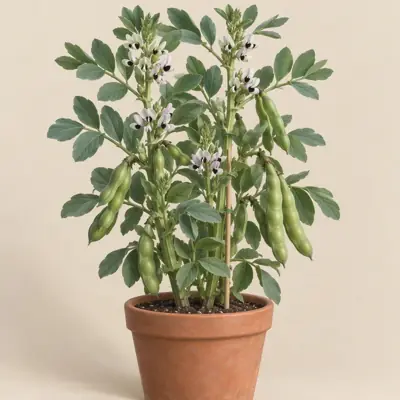
Sources differ on mature height, placing it at about 50–180 cm, while the few available sources report a mature spread of about 10–50 cm. It is reported to grow rapidly and has gray-green to blue-green pinnately compound leaves whose leaflets lack an effective climbing tendril or have a highly reduced tendril. The butterfly-shaped flowers are commonly white to pale purple with dark purple to black markings on the wing petals; some types have dark red, fragrant flowers. The fruit is a thick pod, green when young and dark brown to black when mature or dry, sometimes with a hairy surface; cultivated forms commonly have large pods containing several flattened seeds.
Light
It is reported to prefer full sun.
Watering
It prefers moist but well-drained soil and has some drought tolerance after establishment.
Temperature and dormancy
Sources differ on the ideal temperature, placing it at about 18–27 °C.
Growing medium and mounting
It can grow in clay, loam, sand, and chalky soils, prefers moist but well-drained loam, tolerates clay and saline-alkaline conditions, and can grow in acidic, neutral, or alkaline soil.
Common problems
Aphids are reported to damage flowers and leaves. High temperatures can result in poor yields. As a cool-season crop, excessively high temperatures during growth can affect flowering and pod set, and hot, dry regions are less suitable for cultivation during hot periods.
Identification
It is reported to be distinguished by erect, often four-angled stems, pinnately compound leaves without effective climbing tendrils, white or pale-purple butterfly-shaped flowers often bearing dark markings, and large, thick pods.
Photos


Sources
- Wikipedia (en): Vicia faba — CC BY-SA 4.0 · link
- 維基百科:蚕豆 — CC BY-SA 4.0 · link
- Wikipedia (ja): ソラマメ — CC BY-SA 4.0 · link
- Wikipedia (de): Ackerbohne — CC BY-SA 4.0 · link
- Wikipedia (fr): Vicia faba — CC BY-SA 4.0 · link
- Wikipedia (es): Vicia faba — CC BY-SA 4.0 · link
- GBIF descriptions: Manual of the Alien Plants of Belgium; Checklist of introduced taxa in Cyprus; Database of Vascular — per dataset · link
- NC State Plant Toolbox: Vicia faba — copyright (facts only) · link
- Useful Tropical/Temperate Plants: Vicia faba — CC BY-NC-SA 3.0 (facts only) · link
- RHS Plants: Vicia faba — © RHS, facts only · link
- USDA PLANTS Database: Vicia faba — Public domain (US Government work) · link