
candyleaf (Stevia rebaudiana)
Stevia rebaudiana is an upright herbaceous plant that may become clumping or shrub-like at maturity. It is a perennial herb and is also commonly grown as an annual in colder regions.
Overview
Stevia rebaudiana is an upright herbaceous plant that may become clumping or shrub-like at maturity. It is a perennial herb and is also commonly grown as an annual in colder regions.
Origin and habitat
Sources differ in their descriptions of its native range, placing it in South America, especially Brazil and Paraguay, and describing it as native to tropical to subtropical parts of the Americas. Sources differ on its wild habitat, describing grasslands, mountainous areas, and marsh margins, with some accounts indicating semi-arid habitats and others sandy acidic soils where the water table is relatively shallow. It favors warm, sunny tropical to subtropical climates with some humidity and can also be grown in warmer temperate regions with little frost.
Characteristics
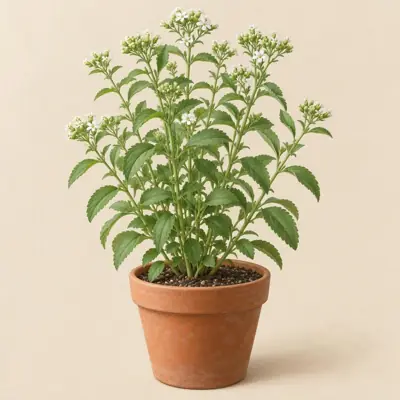
Sources differ on mature height, placing it at about 50–100 cm, while mature spread is 50–100 cm. Sources differ somewhat on the leaves: they are simple and usually described as opposite, with shapes ranging from elliptic and obovate to oblanceolate or lanceolate; their margins may be coarsely toothed or notched, and their surfaces may be hairy. Sources differ somewhat on the flowers, which are described as small, white, tubular, sometimes tinged pale purple, generally without a noticeable fragrance, and borne in loose inflorescences; flowering occurs mainly from summer into autumn, is promoted by short-day conditions, and varies with location and growing conditions. The fruit is a ridged achene that may turn brown when mature; some sources describe a pappus and wind dispersal, while a single source reports that plants can be harvested after establishment and repeatedly thereafter under suitable conditions.
Light
Full sun is best, though partial shade is tolerated, and longer periods of light support leaf growth.
Watering
Keep the soil moist but well drained and avoid prolonged waterlogging; watering can be regular, with more water supplied after the surface soil dries slightly.
Humidity and airflow
Stevia rebaudiana prefers high humidity.
Temperature and dormancy
With few sources available, the reported ideal temperature is about 18–30 °C. Few sources report a lower temperature of about -6 °C and an upper temperature of about 43 °C. Sources differ on its hardiness classifications. It is generally reported to be frost tender; keep above freezing.
Growing medium and mounting
It prefers well-drained sandy or loamy soil and can be grown in organic-rich, slightly acidic soil.
Feeding
A single source reports regular feeding during the growing season.
Propagation
It can be propagated from seed or cuttings, with non-flowering shoots used for cuttings in spring.
Common problems
Thrips are reported as a possible pest, and viral diseases are reported as a possible problem. A single source reports that the delicate leaves may wilt when moisture is insufficient and that plants may decline after entering reproductive flowering growth, with new shoots after pruning still liable to flower again. The plant is sensitive to frost; tender tissue can be severely damaged around freezing conditions, and in cold regions it is best moved to a protected environment before frosts.
Identification
Stevia rebaudiana is upright and bears small white flowers.
Photos


Sources
- Wikipedia (en): Stevia rebaudiana — CC BY-SA 4.0 · link
- 維基百科:甜叶菊 — CC BY-SA 4.0 · link
- Wikipedia (ja): ステビア — CC BY-SA 4.0 · link
- Wikipedia (de): Stevia rebaudiana — CC BY-SA 4.0 · link
- Wikipedia (fr): Stevia rebaudiana — CC BY-SA 4.0 · link
- Wikipedia (es): Stevia rebaudiana — CC BY-SA 4.0 · link
- GBIF descriptions: Listado de especies de plantas útiles comercializadas en los mercados del distrito de Barranquilla, — per dataset · link
- NC State Plant Toolbox: Stevia rebaudiana — copyright (facts only) · link
- Wikipedia (it): Stevia rebaudiana — CC BY-SA 4.0 · link
- Wikipedia (nl): Honingkruid — CC BY-SA 4.0 · link
- TaiCOL 臺灣物種名錄: Stevia rebaudiana — CC BY 4.0 · link
- 農業知識入口網 植物圖鑑: Stevia rebaudiana — © MOA, facts only · link
- Useful Tropical/Temperate Plants: Stevia rebaudiana — CC BY-NC-SA 3.0 (facts only) · link
- RHS Plants: Stevia rebaudiana — © RHS, facts only · link