
spinach (Spinacia oleracea)
Spinacia oleracea is a herbaceous leafy vegetable, primarily annual but occasionally biennial.
Overview
Spinacia oleracea is a herbaceous leafy vegetable, primarily annual but occasionally biennial.
Origin and habitat
Sources differ on its native range, placing it broadly from Central Asia to Western Asia. Information on genuinely wild habitat is limited; it is now mainly found in agricultural, horticultural, and cultivated settings. It prefers cool conditions and tolerates cold; it is a long-day plant, and heat or dry conditions readily promote bolting and reproductive growth.
Characteristics
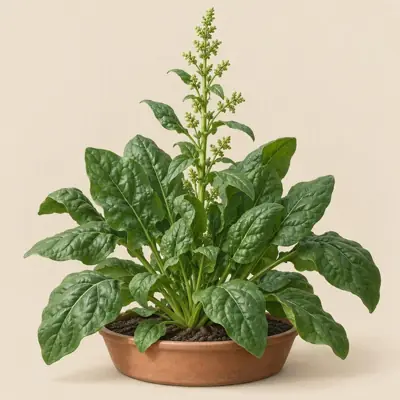
Sources differ on mature height, reporting about 30–100 cm, while a single source reports a mature spread of about 10–50 cm. Growth is rapid, and the green to dark-green simple leaves vary in shape from ovate and triangular to hastate, with larger basal leaves, smaller upper leaves, margins that may be entire or notched, and wrinkled surfaces in some cultivars. The flowers are small and inconspicuous, usually green to yellow-green and wind-pollinated; plants are usually dioecious, though monoecious plants or bisexual flowers may occasionally occur. A single source reports a flowering season later in the year and describes dry fruits that may be spiny or spineless depending on cultivar or type, including small hard fruit aggregates and, in cultivated forms, rounded smooth single-seeded fruits.
Light
It grows in full sun to partial sun; moderate shade during hot conditions favors continued leaf growth, while crops grown in colder conditions are better suited to positions with ample sunlight.
Watering
During growth it needs consistent moisture and suits moist but well-drained soil; dry conditions promote faster bolting.
Temperature and dormancy
Sources are few and differ on minimum temperature, with a reported value of about -10 °C. A single source reports an ideal range of about 15–20 °C.
Growing medium and mounting
Sources differ in detail, but fertile, organic-rich, well-drained soil that maintains consistent moisture is preferred; most information indicates acidic soil is unfavorable, while sources differ on the specific optimum pH.
Feeding
It favors fertile soil rich in organic matter and nitrogen and has relatively high nitrogen requirements.
Propagation
Spinacia oleracea is propagated from seed, which can be sown directly.
Common problems
Potential pests include slugs, pigeons, and leaf miners. Downy mildew is an important disease, and sources also mention white rust, leaf spot, and wilt. Heat, long days, or dry conditions readily promote bolting, while acidic or otherwise unsuitable soil conditions may affect growth. It tolerates cold but dislikes heat; young plants can withstand subzero conditions, and moderate shade during hot periods is more favorable.
Identification
A single source describes Spinacia oleracea as a cool-season leafy vegetable that commonly forms a basal cluster of leaves before producing an upright flowering stem, with highly variable leaf shapes, usually dioecious plants, and a taproot that may be red or reddish.
Photos


Sources
- Wikipedia (en): Spinach — CC BY-SA 4.0 · link
- 維基百科:菠菜 — CC BY-SA 4.0 · link
- Wikipedia (ja): ホウレンソウ — CC BY-SA 4.0 · link
- Wikipedia (de): Spinat — CC BY-SA 4.0 · link
- Wikipedia (fr): Épinard — CC BY-SA 4.0 · link
- Wikipedia (es): Spinacia oleracea — CC BY-SA 4.0 · link
- GBIF descriptions: Manual of the Alien Plants of Belgium; Checklist of introduced taxa in Cyprus; Database of Vascular — per dataset · link
- NC State Plant Toolbox: Spinacia oleracea — copyright (facts only) · link
- TaiCOL 臺灣物種名錄: Spinacia oleracea — CC BY 4.0 · link
- Useful Tropical/Temperate Plants: Spinacia oleracea — CC BY-NC-SA 3.0 (facts only) · link
- RHS Plants: Spinacia oleracea — © RHS, facts only · link
- USDA PLANTS Database: Spinacia oleracea — Public domain (US Government work) · link