
garden tomato (Solanum lycopersicum)
Solanum lycopersicum is herbaceous and may grow upright, spreading, climbing, or eventually become prostrate. Sources differ on its life cycle: it is usually grown as an annual but may be perennial in suitable conditions.
Overview
Solanum lycopersicum is herbaceous and may grow upright, spreading, climbing, or eventually become prostrate. Sources differ on its life cycle: it is usually grown as an annual but may be perennial in suitable conditions.
Origin and habitat
Sources differ on its native range, placing it in western South America. Its original wild habitat is unclear, and it is now widely cultivated around the world. It is a warm-season plant that can be cultivated in tropical, subtropical, and temperate climates, with protected cultivation also common in temperate regions.
Characteristics
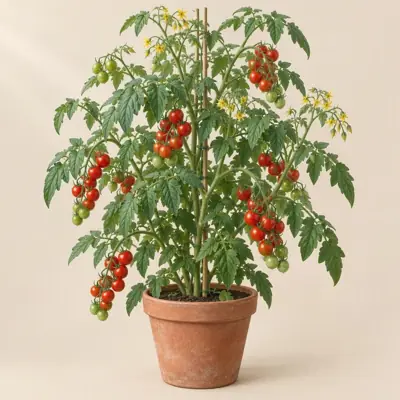
Mature plants range from 30–250 cm in height. A single source reports a mature spread of about 50–100 cm, so sources are few. The leaves are compound, usually odd-pinnate or deeply divided, and the stems and leaves are hairy. The yellow flowers have star-shaped to radiating corollas, may occur in cymose structures, and can self-pollinate; the fruit is botanically a fleshy berry, green when immature and varying by cultivar in mature size, shape, and color, with red or yellow among the common mature colors.
Light
A single source reports that it grows in full sun.
Watering
A single source recommends regular watering to keep the growing medium evenly moist but well drained.
Temperature and dormancy
A single source provides the temperature information, so sources are few: the reported minimum is about 7 °C, the ideal range about 20–27 °C, and the maximum about 35 °C.
Growing medium and mounting
A single source reports that clay, loam, or sandy soil can be used, with a moist but well-drained medium that is acidic to neutral.
Feeding
A single source recommends balanced liquid fertilizer during the growing period, switching to a high-potassium liquid fertilizer after fruit set begins.
Propagation
A single source reports that plants can be started from seed in a heated greenhouse or on a warm windowsill, then moved outdoors or into an unheated greenhouse after the risk of frost has passed.
Common problems
Plants may be affected by various insect pests and root-knot nematodes. Common problems include early blight, late blight, gray mold, leaf spot, bacterial spot, bacterial wilt, wilt diseases, and various tomato virus diseases. A single source also reports physiological problems such as blossom-end rot. The plant is sensitive to frost and does not tolerate it; outdoor planting is recommended after the risk of frost has passed.
Identification
Solanum lycopersicum has hairy stems and leaves, yellow flowers, and fleshy berries; its foliage may have a distinctive tomato odor.
Photos


Sources
- Wikipedia (en): Tomato — CC BY-SA 4.0 · link
- 維基百科:番茄 — CC BY-SA 4.0 · link
- Wikipedia (ja): トマト — CC BY-SA 4.0 · link
- Wikipedia (de): Tomate — CC BY-SA 4.0 · link
- Wikipedia (fr): Tomate — CC BY-SA 4.0 · link
- Wikipedia (es): Solanum lycopersicum — CC BY-SA 4.0 · link
- GBIF descriptions: Manual of the Alien Plants of Belgium; Checklist of introduced taxa in Cyprus; Database of Vascular — per dataset · link
- NC State Plant Toolbox: Solanum lycopersicum — copyright (facts only) · link
- Useful Tropical/Temperate Plants: Solanum lycopersicum — CC BY-NC-SA 3.0 (facts only) · link
- RHS Plants: Solanum lycopersicum — © RHS, facts only · link
- USDA PLANTS Database: Solanum lycopersicum — Public domain (US Government work) · link