
Rosemary (Salvia rosmarinus)
Salvia rosmarinus is an aromatic, woody, evergreen perennial shrub or small shrub, with cultivated forms that may grow upright or trail.
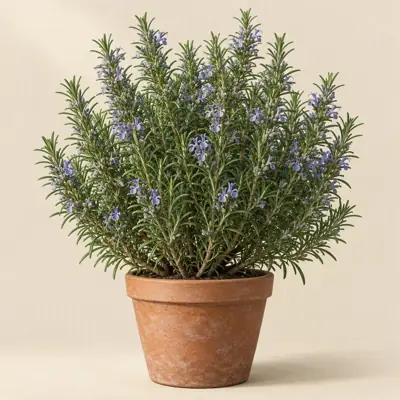
Overview
Salvia rosmarinus is an aromatic, woody, evergreen perennial shrub or small shrub, with cultivated forms that may grow upright or trail.
Origin and habitat
Sources differ on its native range: it is mainly native to the Mediterranean region, while accounts also specifically mention Portugal and northwestern Spain and, more broadly, Africa, Europe, and western Asia. It commonly occurs in dry, rocky Mediterranean habitats and scrub, from coastal to low-mountain areas, and favors dry, well-drained conditions. It is reported to suit hot, relatively dry, sunny climates, especially Mediterranean-type climates with little summer rain and wetter winters that are usually above freezing.
Characteristics
Sources differ on mature height, placing it at about 50–200 cm, while a single source reports a mature spread of about 50–120 cm. Sources differ in their descriptions of the leaves, which are opposite, narrow-linear to needle-like and leathery, with down-rolled margins, green to dark-green upper surfaces, densely hairy white to grayish-white undersides, and a strong aroma. The small, two-lipped flowers occur in leaf axils or in clusters along the branches and are commonly blue to purple, but may also be white or pink; sources differ on flowering time, which varies greatly with climate and cultivar and may occur in spring and summer in temperate climates, mainly from late winter to spring in some areas, or intermittently throughout the year in warm conditions. The fruit is reported to consist of small nutlet-like segments that are ovoid to nearly spherical.
Light
It is reported to favor abundant sunlight, which supports growth, and it can also be grown indoors where sunlight is good.
Watering
It is reported to tolerate drought, while excessive watering and prolonged wetness should be avoided because excess moisture can lead to poor growth or root rot.
Growing medium and mounting
It is reported to prefer well-drained soil and can grow in dry, somewhat sandy and relatively poor soil, with adaptation to soils ranging from alkaline to mildly acidic.
Feeding
Appropriate feeding is reported to support growth, and seedlings may be given additional fertilizer after establishment once clear growth begins.
Propagation
It is reported to be propagated by seed or cuttings; seed may be sown in spring, branch cuttings may be taken in spring or autumn, and cuttings can also be propagated in water.
Common problems
Aphids may damage flowers and leaves, although another source broadly describes pest problems as relatively uncommon. Southern blight-related problems and root rot associated with excess moisture are reported concerns, while excessive watering or overly wet conditions may also lead to plant decline. It is reported to tolerate dry conditions and favor hot, dry environments while also having some cold tolerance; Mediterranean-type growing conditions with winter temperatures above freezing are described as more suitable.
Identification
Salvia rosmarinus is an evergreen aromatic shrub distinguished by narrow, needle-like, leathery leaves with green upper surfaces and densely hairy white undersides, together with small two-lipped flowers that may be blue-purple, white, or pink.
Photos


Sources
- Wikipedia (en): Rosemary — CC BY-SA 4.0 · link
- 維基百科:迷迭香 — CC BY-SA 4.0 · link
- Wikipedia (ja): ローズマリー — CC BY-SA 4.0 · link
- Wikipedia (de): Rosmarin — CC BY-SA 4.0 · link
- Wikipedia (fr): Romarin — CC BY-SA 4.0 · link
- Wikipedia (es): Salvia rosmarinus — CC BY-SA 4.0 · link
- NC State Plant Toolbox: Salvia rosmarinus — copyright (facts only) · link