
kitchen sage (Salvia officinalis)
Salvia officinalis is a perennial, evergreen, aromatic, much-branched subshrub to herbaceous perennial whose base or stems may become woody; sources differ in how its habit is described.
Overview
Salvia officinalis is a perennial, evergreen, aromatic, much-branched subshrub to herbaceous perennial whose base or stems may become woody; sources differ in how its habit is described.
Origin and habitat
Sources differ on its native range, describing it as native to the Mediterranean region and southern Europe. It occurs in dry grassland, scrub, slopes, rocky ground, scree, and rocky outcrops, favoring well-drained, relatively dry habitats. It is adapted to Mediterranean-type environments and prefers sunny, relatively dry, well-drained conditions.
Characteristics
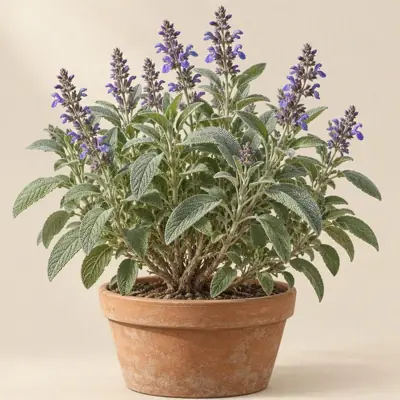
Sources differ on mature height, placing it at about 30–100 cm, while mature spread is 50–100 cm. The opposite leaves are oblong to ovate, wrinkled, and softly hairy or woolly, typically gray-green, whitish green, or blue-gray; some cultivars have purple or variegated foliage. Sources differ in their flower descriptions: the lipped flowers are typically blue-purple to pale blue but may also be white or pink, and are arranged in terminal inflorescences. Flowering is mainly from late spring through summer; the fruit is reported to be a schizocarp composed of nearly spherical nutlets that become dark brown when mature.
Light
It prefers full sun, though some horticultural sources also accept partial sun.
Watering
It does best in well-drained soil ranging from moderately moist to dry, tolerates some drought and poor soil, and does not tolerate waterlogging or poor drainage.
Temperature and dormancy
A single source reports a hardiness-zone range without sufficiently precise numerical information to state it here. A single source describes it as frost tender and recommends keeping it above freezing.
Growing medium and mounting
It grows in well-drained to moist but well-drained soil, including loam, sand, and chalk, and can tolerate relatively poor soil; sources accept acidic, neutral, or alkaline conditions.
Propagation
It is reported to be propagated by cuttings, with summer cuttings described as readily successful.
Common problems
A single source reports Southern Blight as a problem. A single source reports that overly wet or poorly drained soil is unsuitable and that plants may become leggy without appropriate pruning. It prefers full sun and relatively dry conditions; sources differ on cold tolerance, with a horticultural source describing frost sensitivity while another gives a hardiness rating.
Identification
The whole plant is distinctly aromatic, and the stem base becomes woody with growth; its conspicuous gray-green to blue-gray leaves are wrinkled and softly hairy, and the typical leaf color also gave rise to the color name “sage green.”
Photos


Sources
- GBIF Backbone: Salvia officinalis L. — CC BY 4.0 · link
- Wikipedia (en): Salvia officinalis — CC BY-SA 4.0 · link
- 維基百科:藥用鼠尾草 — CC BY-SA 4.0 · link
- Wikipedia (ja): セージ — CC BY-SA 4.0 · link
- Wikipedia (de): Echter Salbei — CC BY-SA 4.0 · link
- Wikipedia (fr): Sauge officinale — CC BY-SA 4.0 · link
- Wikipedia (es): Salvia officinalis — CC BY-SA 4.0 · link
- GBIF descriptions: Manual of the Alien Plants of Belgium; Database of Vascular Plants of Canada (VASCAN); Checklist of — per dataset · link
- NC State Plant Toolbox: Salvia officinalis — copyright (facts only) · link
- Wikipedia (it): Salvia officinalis — CC BY-SA 4.0 · link
- Wikipedia (nl): Echte salie — CC BY-SA 4.0 · link
- Wikipedia (pt): Salvia officinalis — CC BY-SA 4.0 · link
- Useful Tropical/Temperate Plants: Salvia officinalis — CC BY-NC-SA 3.0 (facts only) · link
- RHS Plants: Salvia officinalis — © RHS, facts only · link