
White Mulberry (Morus alba)
Morus alba is a deciduous tree that may also have a shrub-like form, with a rounded or spreading crown. It is perennial and is generally deciduous in temperate climates but may remain evergreen in tropical environments.
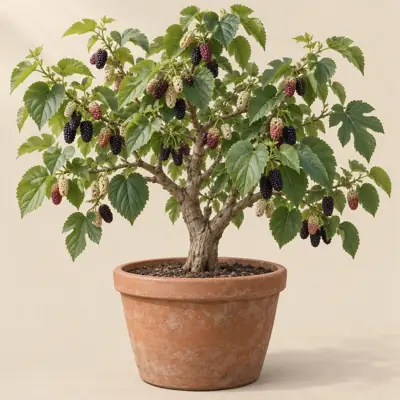
Overview
Morus alba is a deciduous tree that may also have a shrub-like form, with a rounded or spreading crown. It is perennial and is generally deciduous in temperate climates but may remain evergreen in tropical environments.
Origin and habitat
Sources differ on its native range: China is considered its core native area, while some accounts extend the range to India or more broadly across temperate Asia. It is widely cultivated and naturalized beyond its native range, occurring in fields, forest margins, and along roads, although some sources note that its genuinely wild habitat is unclear. It is suited to warm-temperate through subtropical climates and can also be cultivated at some elevations in tropical environments.
Characteristics
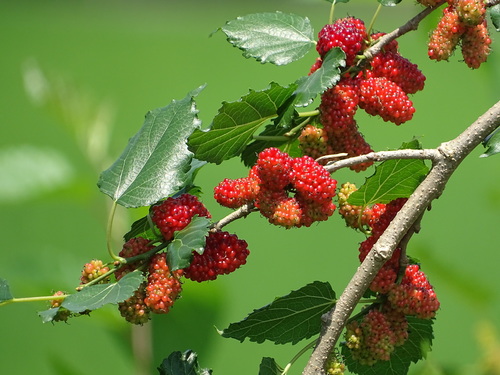
Sources differ on mature height, placing it at about 1000–2000 cm; reports of mature spread are few, with about 1524–1829 cm reported. Sources differ in describing its growth rate as moderate to relatively fast; the alternate leaves are highly variable, ranging from ovate to heart-shaped and from undivided in outline to deeply lobed, with serrated margins, and they may turn pale yellow or yellow in autumn. The small, inconspicuous yellow-green to pale green unisexual flowers occur in inflorescences, with male flowers commonly forming longer catkins; sources differ on whether plants are dioecious or monoecious, and flowering occurs from spring to early summer. The aggregate, berry-like fruit is sweet and may mature to white, pink, reddish purple, nearly black, or dark purple depending on the plant or cultivar.
Light
Full sun is best, though Morus alba tolerates light shade or partial sun.
Watering
Morus alba prefers moist but well-drained soil, while established plants have some drought tolerance.
Temperature and dormancy
Reports are few, with an ideal temperature of about 20–28 °C and reported limits of about -5 °C and about 45 °C. It is generally rated RHS H5.
Growing medium and mounting
Morus alba adapts to sandy, loamy, and clay soils and prefers deep, fertile, humus-rich soil that is moist but well drained; acidic, neutral, and alkaline soils are all suitable.
Propagation
Morus alba is reported to be propagated by seed, by semi-ripe cuttings in summer, and by hardwood cuttings in autumn.
Common problems
Mulberry whitefly may occur, although the RHS broadly describes Morus alba as generally having few pest problems. Mulberry leaf spot may occur, and sources also report that the fruit can be affected by fungi associated with mulberry sclerotial disease. Fallen fruit is reported to stain concrete paths, patios, or vehicles; the plant may escape cultivation and become weedy, and its root system is relatively shallow. It tolerates heat and some drought, while young shoots are sensitive to low temperatures; sources also advise protection from cold, drying winds.
Identification
Leaf shape can vary markedly on the same plant, with leaves on young shoots especially prone to deep lobing; broken young twigs can release milky-white sap, and the fruit may mature from pink to purple-black rather than necessarily being white.
Photos


Sources
- Wikipedia (en): Morus alba — CC BY-SA 4.0 · link
- 維基百科:白桑 — CC BY-SA 4.0 · link
- Wikipedia (ja): マグワ — CC BY-SA 4.0 · link
- Wikipedia (de): Weiße Maulbeere — CC BY-SA 4.0 · link
- Wikipedia (fr): Mûrier blanc — CC BY-SA 4.0 · link
- Wikipedia (es): Morus alba — CC BY-SA 4.0 · link
- GBIF descriptions: Manual of the Alien Plants of Belgium; The checklist of alien seed plants of D.R. Congo, based on ev — per dataset · link
- NC State Plant Toolbox: Morus alba — copyright (facts only) · link
- Useful Tropical/Temperate Plants: Morus alba — CC BY-NC-SA 3.0 (facts only) · link
- RHS Plants: Morus alba — © RHS, facts only · link
- USDA PLANTS Database: Morus alba — Public domain (US Government work) · link