
spearmint (Mentha spicata)
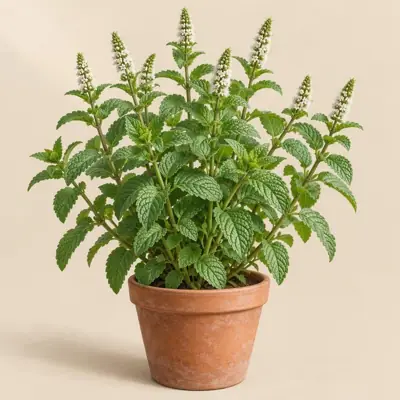
Mentha spicata is an upright, aromatic perennial herb that can form extensive colonies through underground rhizomes.
Overview
Mentha spicata is an upright, aromatic perennial herb that can form extensive colonies through underground rhizomes.
Origin and habitat
Sources differ on its native range: it is mainly native to Europe, extending eastward into western Asia, Central Asia, the Himalayas, and China, while some accounts also include North Africa. It occurs in moist fields, along pond or lake margins, beside roads, and in waste ground, generally favoring environments with moister soil. It is adapted to temperate environments and has become naturalized in many other temperate regions worldwide; dormant plants are highly cold tolerant.
Characteristics
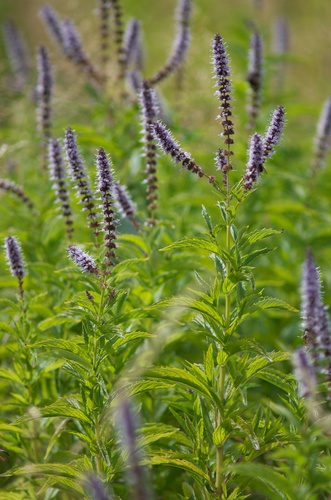
Sources differ on mature size, describing a height of about 30–100 cm and a spread of about 100–150 cm. It grows rapidly, with vigorous rhizomes that can form extensive colonies. The aromatic green leaves are opposite, usually ovate to lance-shaped, pointed, and serrated, and most sources describe them as nearly hairless to sparsely hairy. Small white, pink, or pale purple flowers are densely arranged in slender terminal spikes, with flowering from summer into early autumn; sources differ on the flowering period.
Light
It grows in full sun to partial sun, with sunnier positions preferred for essential-oil production.
Watering
It prefers moist soil and should not remain overly dry for long periods; it can adapt to moist soils ranging from well drained to more poorly drained.
Temperature and dormancy
A single source reports cold tolerance to about -35 °C.
Growing medium and mounting
It adapts to various soils, including clay, loam, sand, and calcareous soils, while preferring moist soil rich in organic matter; acidic, neutral, and alkaline soils can all be suitable.
Propagation
It can be propagated vegetatively through underground rhizomes or runners; division can preserve the parent plant's characteristics, while seedlings may differ from the parent.
Common problems
Vigorous underground rhizomes can spread into unintended areas, and underground root barriers can be used to restrict their expansion. It is not suited to persistently dry soil, while fully dormant plants are highly cold tolerant.
Identification
Mentha spicata has four-angled stems and aromatic leaves with serrated margins and pointed tips; it spreads rapidly through underground rhizomes or creeping structures and produces slender terminal flower spikes.
Photos


Sources
- Wikipedia (en): Spearmint — CC BY-SA 4.0 · link
- 維基百科:留蘭香 — CC BY-SA 4.0 · link
- Wikipedia (ja): スペアミント — CC BY-SA 4.0 · link
- Wikipedia (de): Grüne Minze — CC BY-SA 4.0 · link
- Wikipedia (fr): Mentha spicata — CC BY-SA 4.0 · link
- Wikipedia (es): Mentha spicata — CC BY-SA 4.0 · link
- GBIF descriptions: Database of Vascular Plants of Canada (VASCAN); Checklist of introduced taxa in Romania; Listado de — per dataset · link
- NC State Plant Toolbox: Mentha spicata — copyright (facts only) · link
- Useful Tropical/Temperate Plants: Mentha spicata — CC BY-NC-SA 3.0 (facts only) · link
- RHS Plants: Mentha spicata — © RHS, facts only · link
- USDA PLANTS Database: Mentha spicata — Public domain (US Government work) · link