
Apple (Malus domestica)
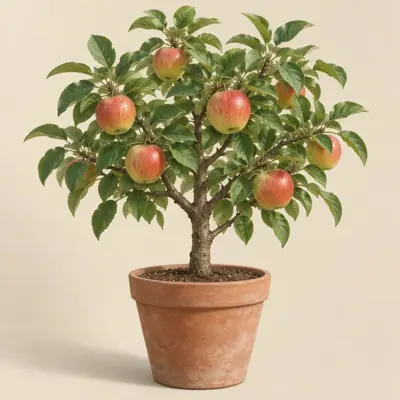
Malus domestica is a deciduous fruit plant, primarily tree-like in habit, although some databases also record a shrub-like form. It is reported to be perennial.
Overview
Malus domestica is a deciduous fruit plant, primarily tree-like in habit, although some databases also record a shrub-like form. It is reported to be perennial.
Origin and habitat
Sources differ on its origin: Central Asia is given as the main origin, while Afghanistan, China, and other parts of Asia are also explicitly mentioned. It is now widely cultivated in managed settings such as orchards, food gardens, and parks, while databases also record it from woodland edges, scrub, and deciduous woodland. It is mainly suited to temperate conditions, entering winter dormancy and requiring a period of cold before spring growth and flowering; cold requirements vary among cultivars.
Characteristics
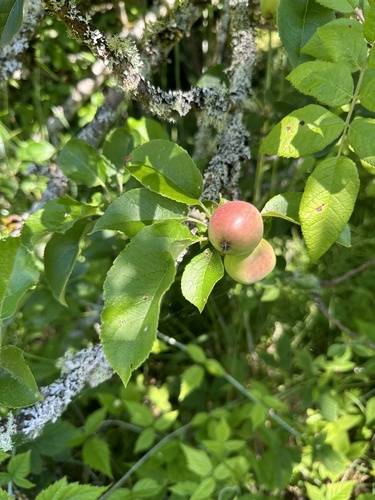
Sources differ, giving a mature height of about 180–460 cm; sources are few. A single source reports a mature spread of about 0–914 cm, so sources are few. The simple, alternate leaves are usually elliptic to ovate and green, generally with serrated margins, and the undersides may be softly hairy. Flowers are usually white to pale pink, with petals, and occur in clusters or cymes; most apple cultivars are self-incompatible and require a genetically different pollination source with overlapping flowering for fruit set. Flowering occurs in spring. The fruit is an apple-type pome, usually nearly spherical or somewhat flattened, with red, yellow, green, pink, or multicolored skin depending on the cultivar and usually pale yellowish-white flesh; it generally ripens from late summer into autumn.
Light
Malus domestica grows in full sun to partial sun.
Watering
The soil is generally reported to be best kept moist but well drained, and established plants are reported to tolerate periods of alternating drier and wetter conditions.
Temperature and dormancy
An RHS hardiness classification is reported for Malus domestica.
Growing medium and mounting
It can grow in chalky, clay, loamy, or sandy soil, with support for acidic, neutral, and alkaline conditions; moist but well-drained soil is emphasized.
Propagation
Cultivars are commonly propagated vegetatively by grafting onto rootstocks to maintain their genetic characteristics and control vigor and plant form, while seedlings often differ greatly from the parent.
Common problems
Various pests can attack Malus domestica, including apple maggot, white apple leafhopper, apple bud moths, and mites. It is susceptible to various fungal and bacterial diseases, with apple powdery mildew and cedar-apple rust specifically mentioned. Pest and disease problems are diverse, and most cultivars may set fruit poorly without compatible pollination trees whose flowering periods overlap. Pronounced winter dormancy and cultivar-dependent cold requirements mean that local winter conditions affect the release from dormancy and subsequent growth and flowering.
Identification
Malus domestica is a deciduous fruit tree with white to pale pink spring flowers followed by large pome fruits; the height, tree form, and branch density of cultivated plants can vary greatly with rootstock and pruning method. 'Gala' is explicitly listed by sources as a cultivar of Malus domestica.
Photos


Sources
- Wikipedia (en): Apple — CC BY-SA 4.0 · link
- 維基百科:苹果 — CC BY-SA 4.0 · link
- Wikipedia (en): Malus domestica — CC BY-SA 4.0 · link
- Wikipedia (ja): セイヨウリンゴ — CC BY-SA 4.0 · link
- Wikipedia (de): Kulturapfel — CC BY-SA 4.0 · link
- Wikipedia (fr): Pommier domestique — CC BY-SA 4.0 · link
- Wikipedia (es): Malus domestica — CC BY-SA 4.0 · link
- GBIF descriptions: Checklist of introduced taxa in Cyprus; Database of Vascular Plants of Canada (VASCAN); Checklist of — per dataset · link
- NC State Plant Toolbox: Malus domestica — copyright (facts only) · link
- RHS Plants: Malus domestica — © RHS, facts only · link
- USDA PLANTS Database: Malus domestica — Public domain (US Government work) · link