
sponge gourd (Luffa aegyptiaca)
Luffa aegyptiaca is an annual climbing herb with tendrils that can climb supports or trail along the ground.
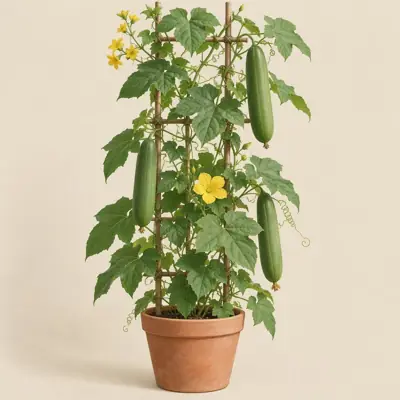
Overview
Luffa aegyptiaca is an annual climbing herb with tendrils that can climb supports or trail along the ground.
Origin and habitat
It is associated with Asia, with most sources pointing to India and areas from South Asia to Southeast Asia, although sources differ and its exact native range is uncertain because of its long history of cultivation. It occurs in disturbed environments such as wasteland, roadsides, fallow scrub, fences, and areas around buildings, and is also widely cultivated. It is suited to warm tropical to subtropical conditions and can also be cultivated in temperate regions with a sufficiently long growing season; it needs ample warmth and protection from frost.
Characteristics
Sources differ on mature height, reporting about 250–1500 cm, while the few available sources report a mature spread of about 50–100 cm. The alternate, long-stalked leaves are large and palmately lobed; their surfaces may be hairy, and white to silvery markings may occur where the veins branch. The plant bears separate yellow male and female flowers on the same plant; male flowers occur in racemes or clusters, female flowers are usually solitary, and the corolla is generally lobed. Flowering occurs from summer into autumn, and the green fruits are mainly elongated and cylindrical, resembling large cucumbers; as they mature, the skin gradually turns brown and dries while a network of fibers and cavities develops inside.
Light
Luffa aegyptiaca grows in full sun, with horticultural sources recommending substantial direct sunlight each day.
Watering
During growth, the soil should remain evenly moist but well drained; excessive rainfall may reduce yield.
Temperature and dormancy
The few available sources report a minimum temperature of about 10 °C, an ideal range of about 23–27 °C, and a maximum of about 38 °C.
Growing medium and mounting
It prefers well-drained, moist loam rich in organic matter, although it can also grow in poorer soils; sources also indicate that loamy or sandy soils can be used and describe a preferred soil reaction with a broader tolerated range.
Common problems
It is reported to be susceptible to pests commonly affecting cucurbit crops and to powdery mildew and downy mildew. Excessive rainfall may reduce yield. It does not tolerate frost; in temperate regions, sowing is recommended after the last frost with a sufficiently long frost-free growing season, and excessive rainfall may also affect yield.
Identification
Luffa aegyptiaca has climbing, angled stems with branched tendrils, large palmately lobed leaves, and separate yellow male and female flowers; mature dried fruits develop a conspicuous network of fibers that is an important identifying feature.
Photos


Sources
- Wikipedia (en): Luffa aegyptiaca — CC BY-SA 4.0 · link
- 維基百科:丝瓜 — CC BY-SA 4.0 · link
- Wikipedia (ja): ヘチマ — CC BY-SA 4.0 · link
- Wikipedia (de): Schwammkürbis — CC BY-SA 4.0 · link
- Wikipedia (fr): Courge éponge — CC BY-SA 4.0 · link
- Wikipedia (es): Luffa aegyptiaca — CC BY-SA 4.0 · link
- GBIF descriptions: Checklist of introduced taxa in Cyprus; Morphology and distribution of species of the family Cucurbi — per dataset · link
- NC State Plant Toolbox: Luffa aegyptiaca — copyright (facts only) · link
- Useful Tropical/Temperate Plants: Luffa aegyptiaca — CC BY-NC-SA 3.0 (facts only) · link
- RHS Plants: Luffa aegyptiaca — © RHS, facts only · link
- USDA PLANTS Database: Luffa aegyptiaca — Public domain (US Government work) · link