
sweet potato (Ipomoea batatas)
Ipomoea batatas is a herbaceous vine whose stems may trail along the ground or climb and can form adventitious roots at the nodes. Sources describe its life cycle differently: it is inherently a perennial herb but is also commonly cultivated as an annual.
Overview
Ipomoea batatas is a herbaceous vine whose stems may trail along the ground or climb and can form adventitious roots at the nodes. Sources describe its life cycle differently: it is inherently a perennial herb but is also commonly cultivated as an annual.
Origin and habitat
Sources differ on its precise center of origin, placing its native range in tropical parts of the Americas, more likely from Central America to northern South America or tropical South America. It is a highly domesticated crop widely cultivated in tropical and subtropical regions, and the sources indicate that no truly wild populations are currently known. It is suited to tropical and subtropical climates and can also be grown as an annual in warmer temperate areas where the growing season is sufficient.
Characteristics
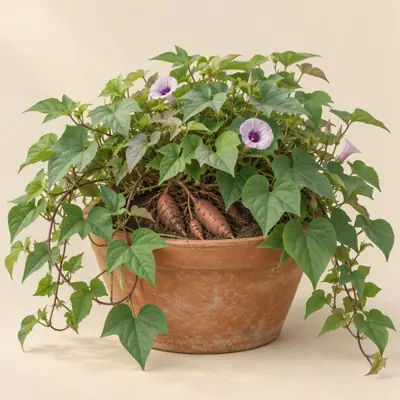
Sources differ on mature size, with height reported at about 250–400 cm and spread at about 50–100 cm. It grows rapidly and spreads vigorously; its highly variable leaves may be ovate, heart-shaped, kidney-shaped, triangular, or lance-shaped, with entire, toothed, or lobed margins, and are usually green, although some cultivars show purple coloration or purple near the veins because of anthocyanins. Sources describe flowering differently: the fused corolla is generally funnel-shaped or bell-shaped and may be pink, white, pale purple, or purple, while flowering ability varies among cultivars; flowering can occur in summer, though some cultivars or plants in temperate environments may flower poorly. The fruit is reported to be a capsule ranging from ovate to flattened-round in shape; fruiting is uncommon and seeds are generally few.
Light
Full sun is best, although partial shade is also tolerated.
Watering
Provide moderate water, keeping the soil moist but well drained and avoiding prolonged waterlogging.
Temperature and dormancy
Sources are few and differ, with a minimum temperature reported at about 7 °C. With few sources, the ideal temperature is reported at about 18–28 °C and the maximum at about 38 °C. A source reports a USDA hardiness-zone classification for the species. It is frost tender; keep above freezing.
Growing medium and mounting
It prefers well-drained sandy loam or loam and can grow in acidic, neutral, or alkaline soil; NC State also recommends soil rich in organic matter.
Feeding
Adequate potassium in the soil is reported to be important for a good harvest.
Propagation
It can be propagated by seed or cuttings; cultivated varieties commonly use rooted shoots arising from storage roots, and stem cuttings also propagate readily.
Common problems
It is reported to be affected by pests associated with sweet potato and by root-knot nematodes. Reported diseases include black rot, Rhizopus soft rot, Fusarium root rot, southern blight, and Geotrichum sour rot. The fast-growing vines can spread outward rapidly and may require control, and white-tailed deer may also feed on the plant. It is sensitive to frost and low temperatures, and tender parts may be severely damaged by cold; frost should be avoided in cold regions.
Identification
It has enlarged, starchy storage roots; these are swollen roots rather than potato-like stem tubers, and their skin and flesh may vary by cultivar among white, yellow, orange, reddish-purple, and purple colors.
Photos


Sources
- Wikipedia (en): Sweet potato — CC BY-SA 4.0 · link
- 維基百科:番薯 — CC BY-SA 4.0 · link
- Wikipedia (ja): サツマイモ — CC BY-SA 4.0 · link
- Wikipedia (de): Süßkartoffel — CC BY-SA 4.0 · link
- Wikipedia (fr): Patate douce — CC BY-SA 4.0 · link
- Wikipedia (es): Ipomoea batatas — CC BY-SA 4.0 · link
- GBIF descriptions: The checklist of alien seed plants of D.R. Congo, based on evidence from herbarium collections; Espe — per dataset · link
- NC State Plant Toolbox: Ipomoea batatas — copyright (facts only) · link
- Wikipedia (pt): Batata-doce — CC BY-SA 4.0 · link
- Wikipedia (ko): 고구마 — CC BY-SA 4.0 · link
- Useful Tropical/Temperate Plants: Ipomoea batatas — CC BY-NC-SA 3.0 (facts only) · link
- RHS Plants: Ipomoea batatas — © RHS, facts only · link
- USDA PLANTS Database: Ipomoea batatas — Public domain (US Government work) · link
- Top Tropicals catalog: Ipomoea batatas — © Top Tropicals LLC (facts only) · link