
Common Sunflower (Helianthus annuus)
Helianthus annuus is a large, upright annual herb.
Overview
Helianthus annuus is a large, upright annual herb.
Origin and habitat
Sources differ on its native range: it is native to North America, with more specific accounts pointing to an area from the western United States to Mexico. It occurs in open sites with dry to moderately moist soils, including fields, roadsides, fence lines, and wasteland, and is also widespread in human-influenced agricultural and horticultural environments. It is a warm-season plant widely cultivated from tropical to warm-temperate regions, especially in subtropical and warm-temperate areas, and favors warm conditions with abundant light.
Characteristics
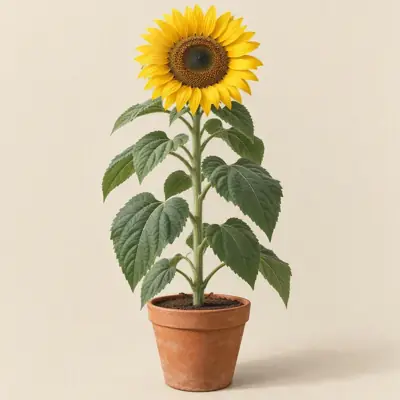
Sources differ on mature height, with reports placing it at about 250–400 cm; the few sources for mature spread report about 50–100 cm. It grows rapidly and has broad, simple leaves that are mostly alternate, ovate to heart-shaped, petioled, coarsely toothed, and rough or hairy to the touch. The apparent flower is actually a large flower head composed of outer ray florets and central disc florets; the ray florets are often yellow, while horticultural forms may also be orange, red, reddish brown, white, or bicolored, and the central disc is often brown, purplish brown, or another dark color. Sources differ on flowering season, describing flowering mainly in summer, sometimes extending into autumn, with a longer flowering period possible under horticultural cultivation; the fruit is reported to be an achene commonly called a sunflower seed, varying among cultivars from dark or nearly black to forms with lighter stripes.
Light
Helianthus annuus prefers full sun.
Watering
It prefers moist but well-drained soil and, once established, is drought tolerant and can also adapt to some dry soils.
Humidity and airflow
It is reported to prefer low humidity.
Temperature and dormancy
Sources differ on the lower temperature limit, with the available report placing it at about 5 °C; the few sources for the upper limit report about 45 °C. It is generally associated with the reported hardiness-zone range and is reported to tolerate brief light frost.
Growing medium and mounting
It is suited to well-drained loam, sandy soil, or clay and can also adapt to relatively infertile soil; sources describe neutral to alkaline soils as suitable and also recommend well-drained sandy loam.
Feeding
It has low fertility requirements; when artificial fertilizer is applied, the plant may accumulate nitrates.
Propagation
It is generally propagated from seed; the reported method involves soaking seed in warm water before sowing it pointed end downward, with germination following under a suitable warm temperature range.
Common problems
Waterlogging is reported to cause sown seeds to rot, while insufficient sunlight can hinder flowering and produce elongated, thin, soft stems. It does not tolerate frost; low temperatures can cause cold injury, and young plants are especially vulnerable to low-temperature damage.
Identification
It is reported to be tall and upright, with a thick, coarsely hairy stem and broad, rough leaves; its large flower heads have conspicuous outer ray florets and numerous central disc florets, with the central florets and seeds arranged in regular spirals, and mature flower heads generally do not follow the sun throughout the day.
Photos


Sources
- GBIF Backbone: Helianthus annuus L. — CC BY 4.0 · link
- Wikipedia (en): Common sunflower — CC BY-SA 4.0 · link
- 維基百科:向日葵 — CC BY-SA 4.0 · link
- Wikipedia (ja): ヒマワリ — CC BY-SA 4.0 · link
- Wikipedia (de): Sonnenblume — CC BY-SA 4.0 · link
- Wikipedia (fr): Tournesol — CC BY-SA 4.0 · link
- Wikipedia (es): Helianthus annuus — CC BY-SA 4.0 · link
- GBIF descriptions: Manual of the Alien Plants of Belgium; The checklist of alien seed plants of D.R. Congo, based on ev — per dataset · link
- NC State Plant Toolbox: Helianthus annuus — copyright (facts only) · link
- Wikipedia (it): Helianthus annuus — CC BY-SA 4.0 · link
- Wikipedia (nl): Zonnebloem — CC BY-SA 4.0 · link
- TaiCOL 臺灣物種名錄: Helianthus annuus — CC BY 4.0 · link
- 農業知識入口網 植物圖鑑: Helianthus annuus — © MOA, facts only · link
- Useful Tropical/Temperate Plants: Helianthus annuus — CC BY-NC-SA 3.0 (facts only) · link