
Wild Carrot (Daucus carota)
Daucus carota is an herbaceous plant with a taproot. It is mainly biennial, although sources describe its life cycle differently.
Overview
Daucus carota is an herbaceous plant with a taproot. It is mainly biennial, although sources describe its life cycle differently.
Origin and habitat
Daucus carota is native across a broad area of the Old World, including Europe, North Africa, and parts of Asia, although sources differ on the precise boundaries in Asia and the Mediterranean region. It occurs in grassland, waste ground, roadsides, old fields, cultivated land, and coastal or cliff habitats, as well as various human-disturbed environments. It is mainly associated with temperate regions and has become widely naturalized outside its native range.
Characteristics
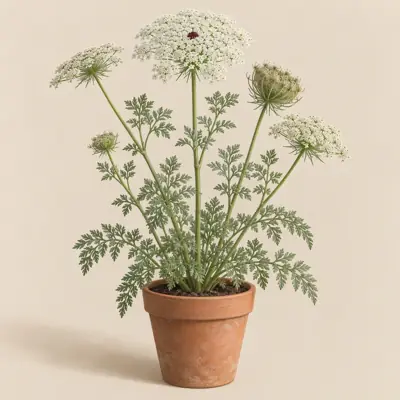
Sources differ on mature height, giving a range of about 30–150 cm; a single source reports a mature spread of about 10–50 cm. The leaves are alternate and deeply divided or pinnate, with an oblong to triangular outline and a finely divided, lacy appearance; the leaves and stems are often coarsely hairy. Small flowers form white compound umbels; buds may be pink, a dark red, purplish-red, or nearly black-purple central floret is often present, and the bracts beneath the inflorescence are often divided or pinnate. Sources differ on the flowering period, with summer described as the main flowering season; the fruit is reported to be a dry, somewhat flattened, ovate to elliptic schizocarp with spines or hooked prickles and hairs.
Light
Full sun is best, though Daucus carota can also adapt to partial shade.
Watering
Well-drained conditions are preferred, and mature plants can cope with alternating wet and dry conditions.
Temperature and dormancy
It is reported to have an RHS hardiness rating and is generally described as frost hardy.
Growing medium and mounting
Daucus carota suits well-drained chalk, loam, or sandy soil; it prefers neutral to alkaline conditions but has some adaptability to soil type and pH.
Common problems
It is reported to serve as an alternative host for pests of cultivated carrots. It is reported to serve as an alternative host for diseases of cultivated carrots. It can spread aggressively and is regarded as invasive in some regions, although sources differ; its long taproot can also make established plants harder to remove.
Identification
Daucus carota has solid, green, hairy stems, finely divided leaves, and a root with a carrot-like smell; its white umbels often have a single dark red or purple central floret and conspicuously divided bracts beneath the inflorescence.
Photos


Sources
- Wikipedia (en): Daucus carota — CC BY-SA 4.0 · link
- 維基百科:野胡萝卜 — CC BY-SA 4.0 · link
- Wikipedia (de): Möhre (Pflanzenart) — CC BY-SA 4.0 · link
- Wikipedia (fr): Daucus carota — CC BY-SA 4.0 · link
- GBIF descriptions: Database of Vascular Plants of Canada (VASCAN); Nordic crop wild relative priority list; Catálogo de — per dataset · link
- NC State Plant Toolbox: Daucus carota — copyright (facts only) · link
- TaiCOL 臺灣物種名錄: Daucus carota — CC BY 4.0 · link
- Useful Tropical/Temperate Plants: Daucus carota — CC BY-NC-SA 3.0 (facts only) · link
- RHS Plants: Daucus carota — © RHS, facts only · link
- USDA PLANTS Database: Daucus carota — Public domain (US Government work) · link