
field pumpkin (Cucurbita pepo)
Cucurbita pepo is an annual herb that may grow as a vine, climber, trailing plant, or clump; some cultivars have compact shoots and fewer tendrils.
Overview
Cucurbita pepo is an annual herb that may grow as a vine, climber, trailing plant, or clump; some cultivars have compact shoots and fewer tendrils.
Origin and habitat
Sources differ on the native range; taken together, they indicate Central America, especially Mexico, extending into the southern United States as the more plausible description. It occurs in a wide range of cultivated settings, including farmland, vegetable gardens, and other horticultural environments, and different types can adapt to dry or moist regions; some sources indicate that genuinely wild habitats are now difficult to confirm. It is reported to be cultivable from temperate to tropical climates and to require a warm growing season; in tropical regions, cultivation at higher elevations is reported to be more suitable.
Characteristics
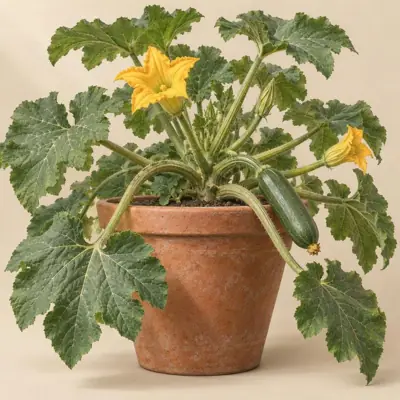
Sources differ on mature height, placing it at about 60–150 cm, while a limited source reports a mature spread of about 100–150 cm. Growth is rapid, and the large, long-petioled leaves are generally heart-shaped to ovate or triangular-heart-shaped and lobed, with finely toothed to serrated margins; some plants have coarse, stiff hairs on the leaf surfaces and petioles. The flowers are yellow to golden yellow and unisexual on the same plant, commonly occurring singly; male and female flowers can be distinguished by their stalks and by the young fruit at the base of female flowers, and flowering occurs from summer into early autumn. Fruit varies greatly among cultivars in shape, size, and color, including round, elongated, ribbed, or warty forms in green, creamy white, yellow, or orange, with flesh ranging from pale yellowish cream to orange.
Light
Cucurbita pepo prefers full sun; it can tolerate light shade, but warm locations with abundant sunlight are preferred in horticultural cultivation.
Watering
Maintain moderate moisture in moisture-retentive but well-drained soil; mulch can help retain soil moisture, and watering can be regular and moderate after the surface soil has dried slightly.
Temperature and dormancy
A limited source reports a temperature range of about 6–40 °C. It is generally reported to tolerate brief light frost.
Growing medium and mounting
It prefers fertile, moisture-retentive but well-drained soil and can grow in loam, clay, sand, and calcareous soil. Sources describe soil reaction differently, ranging from a relatively narrow preference to adaptation across acidic, neutral, or alkaline soils.
Feeding
Compost is reported to be suitable for adding around the plant to encourage growth.
Propagation
It is generally propagated by seed, which is reported to germinate readily when the soil is warm.
Common problems
Recorded pests or feeders include slugs, snails, aphids, and various cucurbit pests; Cucurbita pepo can also host melonworm moth, squash vine borer, and pickleworm. Reported diseases include cucurbit downy mildew, gummy stem blight, anthracnose, and powdery mildew. White-tailed deer are also reported as a possible source of plant damage. Sources differ on weather sensitivity: the plant favors a warm growing season and may die at freezing or colder conditions, while another source reports that mature plants can withstand brief light frost but young plants require protection.
Identification
Cucurbita pepo is extremely variable in appearance within the species; distinguishing features include a hard, ribbed, deeply grooved fruit stalk, stems and petioles that are often coarsely hairy, and palmately lobed leaves. Its many cultivated forms include zucchini, pumpkins, pattypan squash, and other summer- and winter-squash types.
Photos


Sources
- Wikipedia (en): Cucurbita pepo — CC BY-SA 4.0 · link
- Wikipedia (de): Gartenkürbis — CC BY-SA 4.0 · link
- Wikipedia (fr): Cucurbita pepo — CC BY-SA 4.0 · link
- Wikipedia (es): Cucurbita pepo — CC BY-SA 4.0 · link
- GBIF descriptions: Manual of the Alien Plants of Belgium; Checklist of introduced taxa in Cyprus; Database of Vascular — per dataset · link
- NC State Plant Toolbox: Cucurbita pepo — copyright (facts only) · link
- Wikipedia (it): Cucurbita pepo — CC BY-SA 4.0 · link
- Useful Tropical/Temperate Plants: Cucurbita pepo — CC BY-NC-SA 3.0 (facts only) · link
- RHS Plants: Cucurbita pepo — © RHS, facts only · link
- USDA PLANTS Database: Cucurbita pepo — Public domain (US Government work) · link
- Top Tropicals catalog: Cucurbita pepo — © Top Tropicals LLC (facts only) · link