
silver cock's comb (Celosia argentea)
Celosia argentea is an upright, often branching herbaceous plant. Sources differ on its life cycle: it is described as an annual that can behave as a perennial in suitable conditions, while horticulturally it is usually grown as an annual.
Overview
Celosia argentea is an upright, often branching herbaceous plant. Sources differ on its life cycle: it is described as an annual that can behave as a perennial in suitable conditions, while horticulturally it is usually grown as an annual.
Origin and habitat
Sources differ on the native range: tropical Africa is treated as the principal native area, while some accounts describe a broader range that includes tropical parts of Asia. It occurs in open moist ground, hills, field margins, plains and slopes, as well as agricultural, horticultural and other human-influenced environments, and it has been widely cultivated with records of escape and naturalization. It is a tropical plant that can also be cultivated in subtropical and warm-temperate conditions; it favors warm, sunny environments, adapts to hot and humid conditions, and is sensitive to frost and low temperatures.
Characteristics
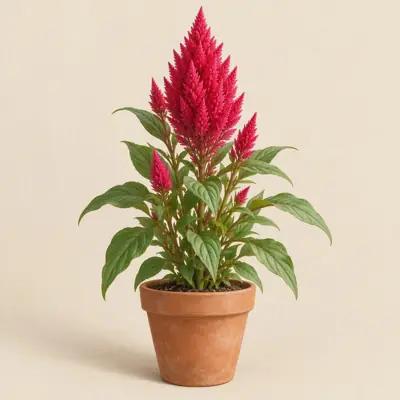
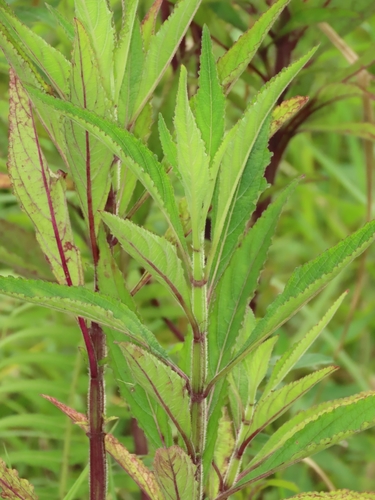
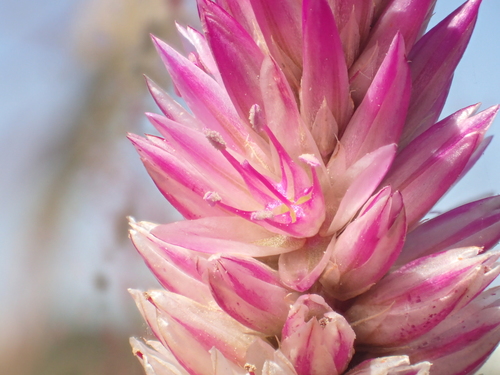
Sources differ, but mature height is reported at about 40–200 cm; sources are few. A single source reports a mature spread of about 10–50 cm, so sources are few. The simple, entire leaves are arranged spirally along the stem; some sources describe them as lance-shaped, and both green-leaved and red-leaved forms occur. The very small flowers are densely grouped into spike-like, panicled or feathery inflorescences, with horticultural forms varying greatly and including feathery or cockscomb-like forms; colors include silvery white, white, pink, red, orange, yellow, purple and cream, flowering is mainly from late spring through autumn with regional and cultivation-related variation, and a single source reports that very small black seeds form inside capsules.
Light
Celosia argentea favors full sun and a sunny position and can grow in hot conditions; one source also advises afternoon shade in very hot areas to reduce overheating.
Watering
The growing medium should retain moderate moisture while draining well; sources recommend ample watering during growth or regular to moderate watering without allowing the medium to dry completely, while also describing some tolerance of dry, porous soil.
Humidity and airflow
Celosia argentea prefers high humidity.
Temperature and dormancy
A single source reports an ideal temperature of about 25–30 °C, so sources are few. Sources are few: a single source reports a minimum of about 5 °C and a maximum of about 40 °C. A single source gives a USDA hardiness-zone range, while broader evidence describes the plant as frost tender; keep above freezing.
Growing medium and mounting
Celosia argentea prefers fertile, well-drained soil that retains moderate moisture, but it can adapt to various soil types; sources differ in their descriptions of suitable soil acidity and alkalinity.
Feeding
A balanced liquid fertilizer can be applied during the growing period, with one source recommending regular feeding.
Propagation
Sources differ on propagation practice: Celosia argentea can be propagated from seed by direct sowing, while horticultural sources also recommend sowing indoors and planting out after the last frost.
Common problems
A single source reports possible problems from aphids, noctuid larvae, spider mites and stem-boring pests, with spider mites more likely under persistently dry conditions. A single source reports damping-off, gray mold and problems associated with repeated cropping, with damping-off and gray mold more likely under poor light or drainage. The plant does not tolerate root disturbance or poorly ventilated, persistently humid conditions, and in some areas it can self-sow or escape cultivation. It tolerates heat but is sensitive to low temperatures and frost, with sources also indicating that sufficiently low temperatures can be lethal and that freezing should be avoided.
Identification
Its most conspicuous feature is the dense, persistent inflorescence; cultivated forms may have narrow elongated feathery, cylindrical spike-like, or broad flattened and folded cockscomb-like inflorescences.
Photos


Sources
- Wikipedia (en): Celosia argentea — CC BY-SA 4.0 · link
- 維基百科:青葙 — CC BY-SA 4.0 · link
- Wikipedia (ja): ケイトウ — CC BY-SA 4.0 · link
- Wikipedia (fr): Celosia argentea — CC BY-SA 4.0 · link
- Wikipedia (es): Celosia argentea — CC BY-SA 4.0 · link
- GBIF descriptions: Checklist of introduced taxa in Romania; Lista de especies de plantas exóticas y trasplantadas de Co — per dataset · link
- NC State Plant Toolbox: Celosia argentea — copyright (facts only) · link
- Wikipedia (pt): Celosia argentea — CC BY-SA 4.0 · link
- TaiCOL 臺灣物種名錄: Celosia argentea — CC BY 4.0 · link
- 農業知識入口網 植物圖鑑: Celosia argentea — © MOA, facts only · link
- Useful Tropical/Temperate Plants: Celosia argentea — CC BY-NC-SA 3.0 (facts only) · link
- RHS Plants: Celosia argentea — © RHS, facts only · link
- USDA PLANTS Database: Celosia argentea — Public domain (US Government work) · link
- Top Tropicals catalog: Celosia argentea — © Top Tropicals LLC (facts only) · link