
cabbage (Brassica oleracea)
Brassica oleracea is an upright to branching, spreading herbaceous plant whose stems may become somewhat woody with age. Sources differ on its life cycle, describing it as biennial to short-lived perennial, while cultivated forms may also be annual to biennial.
Overview
Brassica oleracea is an upright to branching, spreading herbaceous plant whose stems may become somewhat woody with age. Sources differ on its life cycle, describing it as biennial to short-lived perennial, while cultivated forms may also be annual to biennial.
Origin and habitat
Sources differ on its native or origin range: it is associated with Europe, centered on western and southwestern Europe and their Atlantic coasts, while some accounts also include Mediterranean coasts. Wild forms occur mainly in European coastal environments, especially sea cliffs, limestone cliffs, dunes, and gravel areas, and may also occur in cultivated or human-disturbed environments. It is adapted to cool conditions and coastal exposure, and wild forms tolerate coastal salinity and calcareous conditions.
Characteristics
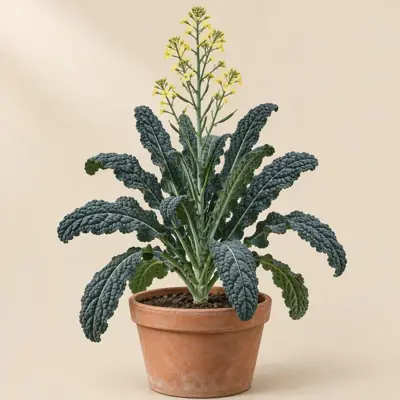
Sources differ on mature height, placing it at about 100–150 cm, while limited source evidence reports a mature spread of about 10–50 cm. Leaves are alternate; lower leaves are large and fleshy, often gray-green to blue-green, and may be stalked, lobed, and wavy or toothed, while upper leaves are smaller and nearly stalkless; the leaves can store water and nutrients. The flowers are yellow to sulfur-yellow, with a cross-shaped arrangement of petals, and are borne on elongated inflorescences. The fruit is a slender pod, green before maturity, containing dark brown seeds.
Light
Full sun is preferred, though partial sun is also accepted.
Watering
Moist but well-drained soil is preferred, and poorly drained conditions should be avoided.
Growing medium and mounting
It prefers fertile, nitrogen-rich, well-drained soil and can grow in sandy, loamy, clay, and chalky soils, with neutral to alkaline or not overly acidic conditions being more suitable.
Feeding
It has relatively high nitrogen requirements and is suited to fertile, nitrogen-rich soil.
Propagation
It is reported to be propagated by seed.
Common problems
It is reported to be susceptible to damage from slugs, snails, aphids, and pests commonly affecting cruciferous vegetables. Its high nitrogen requirements may deplete soil nutrients under repeated cropping, and one source advises against frequent repeated cropping on the same plot. It tolerates substantial coastal exposure, and wild forms are also adapted to saline and calcareous coastal environments.
Identification
Large, fleshy, gray-green to blue-green leaves form a rosette, followed later by upright flowering stems bearing yellow, cross-shaped flowers; the species is highly variable in form.
Photos


Sources
- Wikipedia (en): Brassica oleracea — CC BY-SA 4.0 · link
- Wikipedia (ja): ヤセイカンラン — CC BY-SA 4.0 · link
- Wikipedia (de): Gemüsekohl — CC BY-SA 4.0 · link
- Wikipedia (fr): Chou commun — CC BY-SA 4.0 · link
- Wikipedia (es): Brassica oleracea — CC BY-SA 4.0 · link
- GBIF descriptions: Manual of the Alien Plants of Belgium; The checklist of alien seed plants of D.R. Congo, based on ev — per dataset · link
- NC State Plant Toolbox: Brassica oleracea — copyright (facts only) · link
- Useful Tropical/Temperate Plants: Brassica oleracea — CC BY-NC-SA 3.0 (facts only) · link
- RHS Plants: Brassica oleracea — © RHS, facts only · link
- USDA PLANTS Database: Brassica oleracea — Public domain (US Government work) · link