
Ceylon spinach (Basella alba)
Basella alba is an herbaceous vine with a climbing, twining, or creeping habit. Sources differ on its life cycle, describing it as a short-lived perennial that is often grown as an annual in colder regions.
Overview
Basella alba is an herbaceous vine with a climbing, twining, or creeping habit. Sources differ on its life cycle, describing it as a short-lived perennial that is often grown as an annual in colder regions.
Origin and habitat
Sources differ on the native range, but broadly place it from tropical Asia through South and Southeast Asia, with some accounts also including the Indian subcontinent and New Guinea. It is suited to moist tropical environments and is also found along damp hedges; cultivation and distribution records extend into elevated areas. It prefers a warm to hot, humid tropical climate, tolerates high temperatures but not frost, and grows much more slowly in low temperatures.
Characteristics
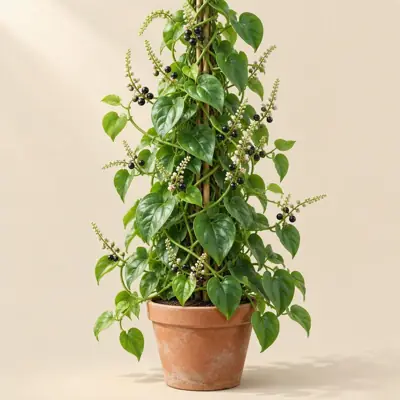
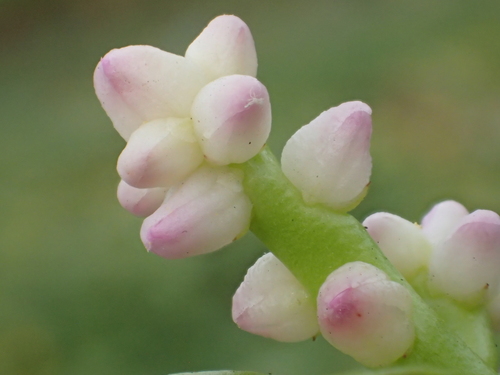
Sources differ on mature height, placing it at about 100–900 cm, while a single source reports a mature spread of about 10–50 cm. Growth is rapid and vigorous in warm seasons; the leaves are reported to be simple, entire, fleshy to semi-succulent, often ovate, broadly ovate, or nearly heart-shaped, with a smooth, glossy surface, usually green but red-purple in some types, and with a slippery texture. The small flowers occur in spikes and may be white, greenish white, pink, pale red, or purple, with green-stemmed forms usually bearing white flowers; one source reports that flowering occurs mainly from summer into autumn and can be induced by short days. A single source reports that mature fruits are glossy and may be deep purple, dark red, or black, and that each fruit usually contains a seed.
Light
Sources differ on light conditions: full sun in a warm, sheltered position is commonly described, while lower light or partial sun can also be suitable; shade may be needed under intense heat and sun to avoid sunburn.
Watering
Basella alba prefers moist but well-drained soil, does not favor dry soil, and can tolerate high rainfall.
Humidity and airflow
It is reported to prefer high humidity.
Temperature and dormancy
The minimum temperature is 10 °C, and the ideal temperature range is 23–30 °C. Sources differ on the upper temperature figure, with limited evidence placing it at about 35 °C. A single source reports its hardiness in USDA zones, and it is frost tender; keep above freezing.
Growing medium and mounting
Basella alba grows best in fertile, organic-rich loam or sandy loam that retains moisture while draining well, although it can adapt to various soils; strongly acidic soil is unfavorable for growth.
Feeding
Fertile, organic-rich soil supports growth, and a Japanese source describes relatively low fertilizer requirements with supplemental feeding after harvesting begins.
Propagation
Basella alba can be propagated from seed or stem cuttings; hard seeds may be soaked before sowing or scarified to encourage germination, and they germinate under suitable temperatures.
Common problems
Pest and disease problems are generally uncommon. Low temperatures rapidly weaken growth, excessively dry or strongly acidic soil impairs growth, and frost is not tolerated. Extremely high temperatures combined with strong sunlight can cause sunburn, for which some shade may be needed.
Identification
Basella alba has vigorous vines and thick, smooth leaves with a distinctly slippery texture; green-stemmed and red-purple-stemmed forms occur, and red-stemmed cultivated forms can have red-purple stems and petioles.
Photos


Sources
- GBIF Backbone: Basella alba L. — CC BY 4.0 · link
- Wikipedia (en): Basella alba — CC BY-SA 4.0 · link
- 維基百科:落葵 — CC BY-SA 4.0 · link
- Wikipedia (ja): ツルムラサキ — CC BY-SA 4.0 · link
- Wikipedia (de): Indischer Spinat — CC BY-SA 4.0 · link
- Wikipedia (fr): Basella alba — CC BY-SA 4.0 · link
- Wikipedia (es): Basella alba — CC BY-SA 4.0 · link
- GBIF descriptions: The checklist of alien seed plants of D.R. Congo, based on evidence from herbarium collections; List — per dataset · link
- NC State Plant Toolbox: Basella alba — copyright (facts only) · link
- Wikipedia (it): Basella alba — CC BY-SA 4.0 · link
- Wikipedia (pt): Basella alba — CC BY-SA 4.0 · link
- Useful Tropical/Temperate Plants: Basella alba — CC BY-NC-SA 3.0 (facts only) · link
- RHS Plants: Basella alba — © RHS, facts only · link
- USDA PLANTS Database: Basella alba — Public domain (US Government work) · link