
pineapple (Ananas comosus)
Ananas comosus is a perennial herb that grows in clumps as a rosette, with a short, thick stem and a terrestrial bromeliad habit.
Overview
Ananas comosus is a perennial herb that grows in clumps as a rosette, with a short, thick stem and a terrestrial bromeliad habit.
Origin and habitat
Sources differ on the native range: it is placed in South America, with more specific accounts pointing to southern Brazil through Paraguay, including the Paraná–Paraguay river basin. It occurs in tropical environments, with savanna reported as a natural habitat, and in cultivation it is mainly adapted to humid lowland tropical conditions while also growing at higher elevations. It favors warm tropical to partly subtropical climates, and commercial cultivation is concentrated mainly in tropical regions.
Characteristics
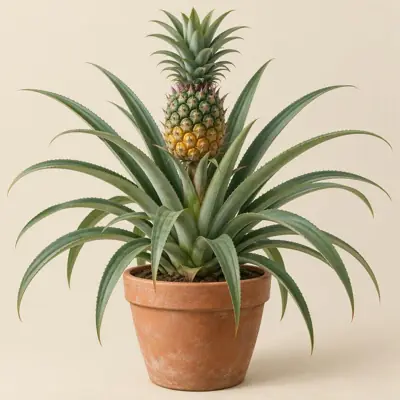
Sources differ on mature height, placing it at about 50–150 cm, while mature spread is 50–152 cm; growth is slow. The evergreen leaves form a dense rosette and are narrow, lance-shaped to strap-like, stiff and waxy, with spines commonly present along the margins and at the tips, although some cultivars may have smoother margins. A dense spike-like or conical inflorescence emerges from the center with many tubular flowers; purple flowers are recorded, accompanied by bracts ranging from red to yellow-red. Sources differ on flowering time, which can occur mainly in summer and varies with climate and growing conditions; the fleshy mature compound fruit forms from multiple flowers at the top of the central flower stalk, is commonly yellow to orange, and bears a leafy crown.
Light
Sources differ on light requirements, describing conditions from bright light to full sun; indoors, bright indirect light with some direct sun can be provided, while insufficient light may result in weaker growth and smaller fruit. It is generally reported to suit bright indirect light.
Watering
During active growth, maintain moderate moisture in a well-drained growing medium, allowing the surface or part of the medium to dry between waterings and avoiding prolonged waterlogging; reduce watering in winter or when growth slows. Water the pot.
Humidity and airflow
It prefers high humidity. It is generally reported to need little air movement.
Temperature and dormancy
The ideal temperature range is 21–30 °C. Sources differ on the lower temperature guidance, which is about 10 °C, while the cold minimum is 10 °C. With few sources, the upper temperature guidance is reported to be about 36 °C. It is generally reported to tolerate brief light frost.
Growing medium and mounting
Use a well-drained, acidic growing medium; reported options include sandy or organic-rich soil, loam, light humus-rich soil, and bromeliad growing medium, with avoidance of waterlogging as the key consideration. It is suited to being potted.
Feeding
Feed during the growing period with a fertilizer having balanced nitrogen, phosphorus, and potassium or slightly more phosphorus; during fruiting, some sources recommend a higher-potassium fertilizer.
Propagation
Propagation is mainly vegetative, using the fruit crown, basal suckers or side shoots, and plantlets forming near the inflorescence; after removal, a crown can be allowed to dry at the cut surface before being inserted into a well-drained medium.
Common problems
Scale insects may occur, and other sources also mention mealybugs and leaf mites. Root rot is a main concern, although some sources report no particularly prominent diseases. Prolonged excessive moisture in the growing medium may cause root rot; indoors, strong direct light combined with insufficient water may cause sunburn or dehydration, while insufficient light may lead to weaker growth and smaller fruit. It is sensitive to frost and prolonged low temperatures, which can cause damage or death, so protection from frost is needed in cold regions.
Identification
It can be recognized by a rosette clump of stiff, strap-like leaves, a dense central inflorescence, and a large fleshy compound fruit topped by a conspicuous leafy crown.
Photos


Sources
- GBIF Backbone: Ananas comosus (L.) Merr. — CC BY 4.0 · link
- Wikipedia (en): Pineapple — CC BY-SA 4.0 · link
- 維基百科:凤梨 — CC BY-SA 4.0 · link
- Wikipedia (ja): パイナップル — CC BY-SA 4.0 · link
- Wikipedia (de): Ananas — CC BY-SA 4.0 · link
- GBIF descriptions: The checklist of alien seed plants of D.R. Congo, based on evidence from herbarium collections; List — per dataset · link
- NC State Plant Toolbox: Ananas comosus — copyright (facts only) · link
- Useful Tropical/Temperate Plants: Ananas comosus — CC BY-NC-SA 3.0 (facts only) · link
- RHS Plants: Ananas comosus — © RHS, facts only · link
- USDA PLANTS Database: Ananas comosus — Public domain (US Government work) · link
- NHK みんなの趣味の園芸 植物図鑑: Ananas comosus — © NHK出版, facts only · link
- Top Tropicals catalog: Ananas comosus — © Top Tropicals LLC (facts only) · link
- How to Grow Indoor Pineapple Plants! (ukhouseplants.com) — facts only (§12) · link
- Pineapple or ananas (Ananas comosus): planting and care (www.nature-and-garden.com) — facts only (§12) · link