
Japanese zelkova (Zelkova serrata)
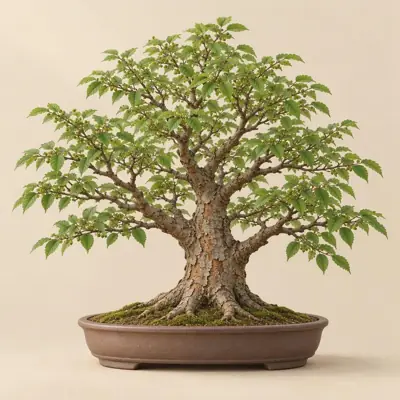
Zelkova serrata is a perennial deciduous, medium to large tree, typically with a short trunk and multiple upward and outward-spreading branches that form a broad crown; young trees often have an elegant vase-shaped form.
Overview
Zelkova serrata is a perennial deciduous, medium to large tree, typically with a short trunk and multiple upward and outward-spreading branches that form a broad crown; young trees often have an elegant vase-shaped form.
Origin and habitat
It is native to East Asia, including Japan, the Korean Peninsula, eastern China, and Taiwan. It occurs from lowlands to mountain areas and is often found in river valleys, beside streams, and on moister slopes or in open woodland. It is associated with temperate East Asian conditions and prefers moister conditions, while established plants have some tolerance of drought and wind.
Characteristics
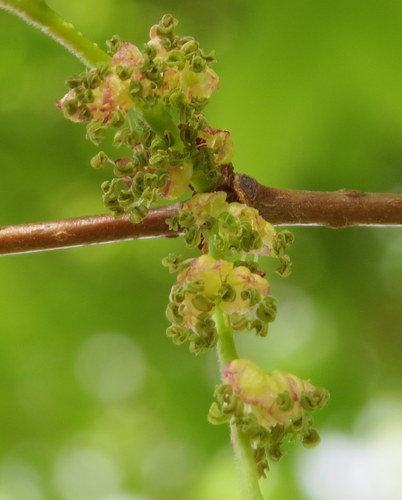
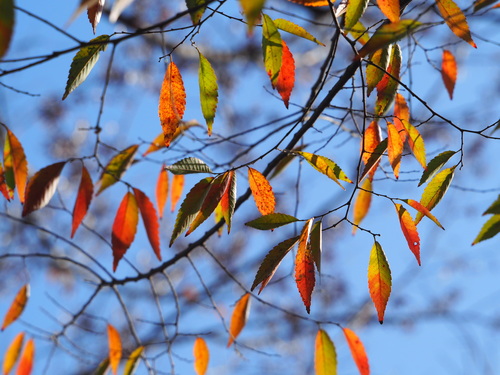
Sources differ on mature height, placing it at about 2000–3500 cm, while the few sources for mature spread report about 1524–2438.4 cm. Sources differ on growth rate, describing rapid growth when young that slows to a moderate rate with age; the alternate, simple leaves range from ovate and elongated ovate to lanceolate, have conspicuously serrated or crenate-serrated margins, are often rough on the surface, and change from green or dark green during the growing period to yellow, orange, red, or reddish brown in autumn. Sources differ in their descriptions of the small, inconspicuous green to yellow-green flowers: male and female flowers can occur on the same plant, with male flowers mostly in lower leaf axils of new shoots and female flowers mostly in upper leaf axils; flowering is generally reported in spring. Sources differ in their descriptions of the very small fruit, which changes from green to brown or dark brown as it matures in autumn.
Light
Zelkova serrata grows in full sun to partial sun, and sources also characterize it as favoring sunny conditions.
Watering
Water needs are moderate; it prefers deep, fertile, moist but well-drained soil, and established plants tolerate some drought.
Temperature and dormancy
An RHS hardiness rating is reported for the species.
Growing medium and mounting
It is suited to deep, fertile, moist, well-drained soil; sources support growth in loam, clay, and calcareous soils under acidic, neutral, or alkaline conditions.
Propagation
It is reported to be propagated by seed, by softwood cuttings from young plants in summer, or by grafting in winter; seed may be sown outdoors in autumn.
Common problems
Sources differ on pest problems: Japanese beetle damage can occur, while the RHS generally regards the species as having few pest problems. Sources differ on disease occurrence: Dutch elm disease and honey fungus can occur, although some sources indicate that actual infection by Dutch elm disease is uncommon. Autumn color varies with environmental conditions; plants in urban environments may turn yellow-brown to brown rather than developing vivid red-orange color. Tender new growth is more susceptible to damage from late spring frost; cultivation should avoid cold, dry winds, while established plants have some wind tolerance.
Identification
A short trunk with multiple obliquely ascending branches forms a vase-shaped to broad-spreading crown; branches are often zigzag, leaves are alternate with distinctive serrations, and bark on older trees can become scaly or peel in mottled patches.
Photos


Sources
- Wikipedia (en): Zelkova serrata — CC BY-SA 4.0 · link
- 維基百科:榉树 — CC BY-SA 4.0 · link
- Wikipedia (ja): ケヤキ — CC BY-SA 4.0 · link
- Wikipedia (de): Japanische Zelkove — CC BY-SA 4.0 · link
- Wikipedia (fr): Zelkova serrata — CC BY-SA 4.0 · link
- Wikipedia (es): Zelkova serrata — CC BY-SA 4.0 · link
- GBIF descriptions: Manual of the Alien Plants of Belgium; The Woody Plants of Korea (한국의 수목); Captura y almacenamiento — per dataset · link
- NC State Plant Toolbox: Zelkova serrata — copyright (facts only) · link
- TaiCOL 臺灣物種名錄: Zelkova serrata — CC BY 4.0 · link
- Useful Tropical/Temperate Plants: Zelkova serrata — CC BY-NC-SA 3.0 (facts only) · link
- RHS Plants: Zelkova serrata — © RHS, facts only · link
- USDA PLANTS Database: Zelkova serrata — Public domain (US Government work) · link