
calla lily (Zantedeschia aethiopica)
Zantedeschia aethiopica is a clumping herbaceous perennial with fleshy rhizomes; it can remain evergreen when moisture and temperature are suitable, but may become deciduous or semi-evergreen under dry or cold conditions.
Overview
Zantedeschia aethiopica is a clumping herbaceous perennial with fleshy rhizomes; it can remain evergreen when moisture and temperature are suitable, but may become deciduous or semi-evergreen under dry or cold conditions.
Origin and habitat
It is native to southern Africa; sources specifically include South Africa, Lesotho and Eswatini, while sources differ on whether Mozambique is also included. It favors moist environments and occurs naturally along streams and pond margins, in marshes and other wetlands, and in habitats such as seasonally wet grassland. Its environments range from warm, moist coastal areas of South Africa to high-elevation mountains with freezing conditions and fog; it may remain evergreen when conditions are warm with ample rainfall and become deciduous during dry or cold periods.
Characteristics
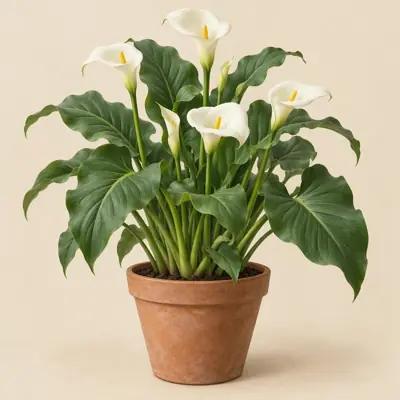
Sources differ on mature height, placing it at about 50–100 cm, while a single source reports a mature spread of about 10–50 cm; sources are few for the spread estimate. It is generally reported to have a moderate growth rate, with basal, long-stalked, arrow-shaped to heart-shaped ovate leaves that are dark or bright green and often form large clumps. The inflorescence has a white to creamy-white, funnel- or hood-shaped spathe surrounding a usually yellow to pale-yellow spadix, with small female flowers below and male flowers above; the spadix may have a faint sweet fragrance. Sources differ on its flowering season, which is described as spring, summer and autumn; after pollination and fertilization it is generally reported to form round, berry-like fruits surrounded by remnants of the spathe.
Light
It can grow in full sun to partial shade and tolerates some direct sun; some sources describe full sun as best for growth, while others describe naturally shaded, moist habitats.
Watering
It has high water needs and suits continuously moist, moisture-retentive or poorly drained soil; it can also be grown as a waterside plant in shallow water.
Temperature and dormancy
Sources differ on minimum temperature, with about -10 °C reported from limited evidence. It is generally described as frost tender; keep above freezing.
Growing medium and mounting
It suits fertile, organic-rich soil that remains moist; clay or loam may be used, and sources list acidic, neutral and alkaline conditions as acceptable. It is rhizomatous and suits a moisture-retentive mix.
Propagation
It can be propagated by dividing rhizomes or by seed; seeds may also be dispersed by birds, while rhizomes can be moved with soil or garden waste and propagate vegetatively.
Common problems
It is reported to be susceptible to greenhouse thrips. It may lose its leaves in summer when soil is drier, and in some suitable regions it readily escapes cultivation and becomes a weed or invasive plant. Typical forms are sensitive to frost and prolonged cold, although rhizomes may overwinter under some conditions and some selected forms are more cold tolerant.
Identification
Zantedeschia aethiopica forms clumps of large, dark-green, arrow-shaped leaves and has conspicuous large white spathes surrounding a central yellow spadix; despite common names containing lily, Arum or calla, it does not belong to the true lily genus, Arum or Calla.
Photos


Sources
- Wikipedia (en): Zantedeschia aethiopica — CC BY-SA 4.0 · link
- 維基百科:马蹄莲 — CC BY-SA 4.0 · link
- Wikipedia (fr): Zantedeschia aethiopica — CC BY-SA 4.0 · link
- Wikipedia (es): Zantedeschia aethiopica — CC BY-SA 4.0 · link
- GBIF descriptions: Manual of the Alien Plants of Belgium; Checklist of introduced taxa in Cyprus; Lista de especies de — per dataset · link
- NC State Plant Toolbox: Zantedeschia aethiopica — copyright (facts only) · link
- Wikipedia (it): Zantedeschia aethiopica — CC BY-SA 4.0 · link
- Wikipedia (nl): Zantedeschia aethiopica — CC BY-SA 4.0 · link
- TaiCOL 臺灣物種名錄: Zantedeschia aethiopica — CC BY 4.0 · link
- Useful Tropical/Temperate Plants: Zantedeschia aethiopica — CC BY-NC-SA 3.0 (facts only) · link
- RHS Plants: Zantedeschia aethiopica — © RHS, facts only · link
- USDA PLANTS Database: Zantedeschia aethiopica — Public domain (US Government work) · link
- Top Tropicals catalog: Zantedeschia aethiopica — © Top Tropicals LLC (facts only) · link