
ZZ plant (Zamioculcas zamiifolia)
Zamioculcas zamiifolia is an upright evergreen perennial herb with fleshy underground rhizomes and water-storing succulent characteristics, and it may shed its leaves during drought.
Overview
Zamioculcas zamiifolia is an upright evergreen perennial herb with fleshy underground rhizomes and water-storing succulent characteristics, and it may shed its leaves during drought.
Origin and habitat
Sources differ on its native range, placing it from eastern to southern Africa, including Kenya, Tanzania, Malawi, Mozambique, Zimbabwe, and the KwaZulu-Natal area of South Africa. It occurs in moist to dry evergreen forest, Brachystegia woodland, dry wooded grassland and scrub, as well as rocky environments, rocky or sandy riverbanks, and partly shaded habitats. Its native environment is tropical to subtropical with seasonal dryness, and the plant is adapted to periodic water shortage.
Characteristics
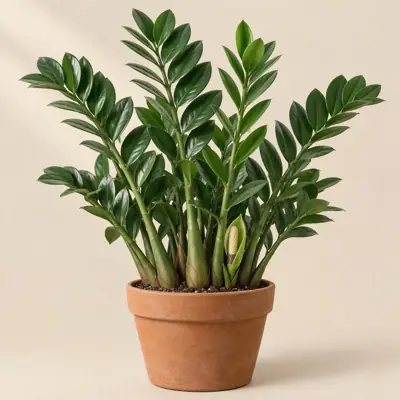
Sources differ on mature height, placing it at about 30–100 cm, while a single source reports a mature spread of about 50–100 cm. Growth is slow to relatively slow, with upright pinnately compound leaves bearing fleshy, thick, glossy dark-green leaflets and stout, water-storing petioles. Sources differ in describing the inflorescence and flowering period: it has a spadix ranging from pale yellow to brown or bronze, enclosed by a pale green, yellow-green, or nearly white spathe and generally positioned near the base of the plant, with flowering mainly from summer to early autumn. It forms white berries containing seeds that are brown and oval.
Light
It grows in bright light or part shade and can also tolerate low light, but prolonged deep shade may produce elongated growth, while strong direct sunlight may scorch the leaves.
Watering
It is drought tolerant; after watering, allow the growing medium to dry thoroughly before watering again, avoid prolonged wetness or standing water, and reduce watering frequency in winter. Sources differ, but winter watering is placed at about every 30–56 days.
Humidity and airflow
A single source reports humidity of about 50–100 %, so sources are few. It is generally reported to prefer low humidity and need moderate airflow.
Temperature and dormancy
Sources differ on the lower temperature figure, placing it at about 5 °C, while the confirmed cold minimum is 5 °C. Few sources place the ideal temperature at about 18–26 °C, while a single source reports an upper figure of about 37.8 °C. Sources differ on its stated USDA hardiness-zone classification, and it is generally reported to tolerate brief light frost.
Growing medium and mounting
It needs a fast-draining mix, such as sandy soil, loam, succulent growing mix, or a well-drained indoor-plant growing mix, and does not tolerate prolonged waterlogging.
Feeding
It can be fertilized during the growing period; one recommendation calls for a slow-release fertilizer with equal proportions of the major nutrients, while another recommends applying a small amount before growth begins and doing so infrequently.
Propagation
It can be propagated by division or from individual leaflets; leaflet cuttings form a small tuber and roots at the base, but new shoots may take a long time to emerge, and propagation by seed and tissue culture has also been recorded.
Common problems
Recorded pests include scale insects, spider mites, aphids, slugs, woodlice, and grasshoppers. Disease problems are generally uncommon, but prolonged wetness in the growing medium can deprive roots of oxygen and cause rhizome rot. The main problems are overwatering and poor drainage, which can cause yellowing, softening, and root or rhizome rot; strong direct sunlight can scorch the leaves. It tolerates drought and high temperatures relatively well but is sensitive to low temperatures and prolonged wetness; strong direct sunlight combined with high temperatures can also make leaf scorch more likely.
Identification
Zamioculcas zamiifolia has thick, potato-like underground rhizomes that store water and upright, thick, dark-green, highly glossy pinnately compound leaves; it resembles Zamia plants in appearance but belongs to the arum family.
Photos


Sources
- Wikipedia (en): Zamioculcas — CC BY-SA 4.0 · link
- 維基百科:美鐵芋 — CC BY-SA 4.0 · link
- Wikipedia (en): Zamioculcas zamiifolia — CC BY-SA 4.0 · link
- Wikipedia (ja): ザミオクルカス — CC BY-SA 4.0 · link
- Wikipedia (de): Zamioculcas zamiifolia — CC BY-SA 4.0 · link
- Wikipedia (fr): Zamioculcas zamiifolia — CC BY-SA 4.0 · link
- Wikipedia (es): Zamioculcas zamiifolia — CC BY-SA 4.0 · link
- GBIF descriptions: CATE Araceae — per dataset · link
- NC State Plant Toolbox: Zamioculcas zamiifolia — copyright (facts only) · link
- Wikipedia (it): Zamioculcas zamiifolia — CC BY-SA 4.0 · link
- RHS Plants: Zamioculcas zamiifolia — © RHS, facts only · link
- NHK みんなの趣味の園芸 植物図鑑: Zamioculcas zamiifolia — © NHK出版, facts only · link
- Top Tropicals catalog: Zamioculcas zamiifolia — © Top Tropicals LLC (facts only) · link
- ZZ Plant Maintenance & Care Checklist - HORTOLOGY (hortology.co.uk) — facts only (§12) · link