
Cycad (Zamia furfuracea)
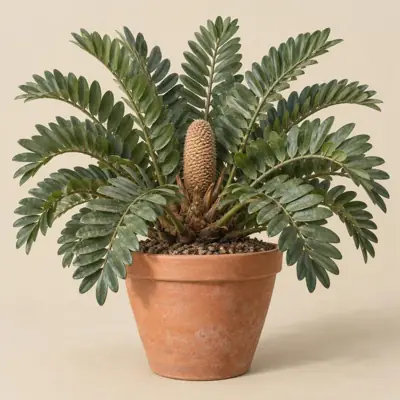
Zamia furfuracea is a perennial, evergreen, shrub-like cycad with a rosette-like crown of leaves arising from the top of the stem; it is not a palm.
Overview
Zamia furfuracea is a perennial, evergreen, shrub-like cycad with a rosette-like crown of leaves arising from the top of the stem; it is not a palm.
Origin and habitat
Sources differ on the native range within Veracruz, Mexico, describing eastern to southeastern Veracruz, with several accounts pointing more specifically to the southeastern part of the state. Its habitat includes sandy savanna or warm sandy coastal plains along eastern Mexico, where it can grow close to seawater. It is adapted to warm tropical to subtropical conditions and tolerates heat and drought, with some salt tolerance.
Characteristics
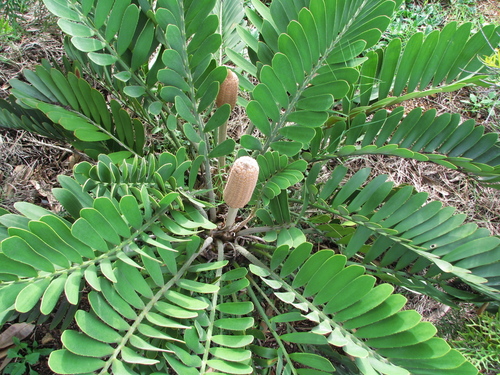
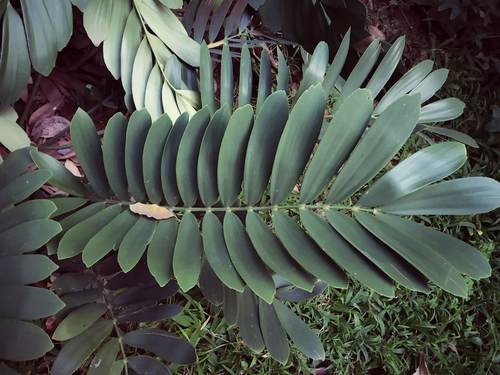
Mature plants reach 61–152 cm in height and 183–200 cm in spread. Growth is slow, especially when young, and becomes faster as the stem matures; pinnate compound leaves form a rosette-like cluster at the stem apex and are thick, leathery, and rigid, with mostly ovate to elliptic leaflets that may have fine hairs or a scaly surface and sometimes finely toothed margins. Plants are dioecious and bear cones rather than flowers; male cones are smaller or conical to cylindrical, while female cones are larger and ovate to cylindrical, and mature female cones expose bright red to scarlet, elliptic seeds rather than true fruits. Sources differ on the reproductive season, but it is mainly reported to occur in summer.
Light
Sources differ on light conditions, but Zamia furfuracea can grow in full sun to partial sun and takes full sun; prolonged deep shade is unsuitable, lower light may lead to elongated leaves, and outdoor full sun can produce a more compact form.
Watering
It is drought tolerant; water thoroughly after the growing medium dries, avoid prolonged wetness or standing water, and keep it drier in winter.
Humidity and airflow
It is reported to prefer low humidity and to need good airflow.
Temperature and dormancy
Sources differ on the cold minimum, with limited information indicating about -4 °C. It generally has a reported hardiness classification but tolerates brief light frost.
Growing medium and mounting
Well-drained sandy or sandy loam soil is preferred; containers can use a well-drained succulent growing medium, and standing water should be avoided. It needs a fast-draining mix.
Feeding
Fertilizer requirements are low; container plants can receive small amounts of balanced fertilizer, while moderate ongoing feeding during active growth may be used to encourage faster growth, and another cultivation recommendation is to apply a slow-release complete fertilizer seasonally.
Propagation
Sources differ, but propagation by seed is described.
Common problems
Scale insects are reported to be more likely in poorly ventilated indoor conditions, often occurring on leaf undersides, with new growth potentially more severely affected. Sources generally report few notable disease problems. Excess moisture can cause root rot, prolonged insufficient light can produce elongated growth, and sudden strong direct light in indoor summer conditions can cause leaf scorch. It tolerates heat and drought and has some salt tolerance, but cold and frost can cause damage, including cold injury to the leaves.
Identification
Distinctive features include broad, thick, extremely rigid leaflets with a fuzzy or scaly texture described as feeling like cardboard, along with a short, thick stem at ground level or partly underground and an overall crown resembling a palm.
Photos


Sources
- Wikipedia (en): Zamia furfuracea — CC BY-SA 4.0 · link
- 維基百科:美叶苏铁 — CC BY-SA 4.0 · link
- Wikipedia (es): Zamia furfuracea — CC BY-SA 4.0 · link
- NC State Plant Toolbox: Zamia furfuracea — copyright (facts only) · link
- USDA PLANTS Database: Zamia furfuracea — Public domain (US Government work) · link
- PACSOA wiki: Zamia furfuracea — © Palm & Cycad Societies of Australia (PACSOA) and credited contributors, facts only · link
- 臺北典藏植物園 植物資料庫: Zamia furfuracea — © 臺北典藏植物園, facts only · link
- NHK みんなの趣味の園芸 植物図鑑: Zamia furfuracea — © NHK出版, facts only · link
- Top Tropicals catalog: Zamia furfuracea — © Top Tropicals LLC (facts only) · link