
Wrightia antidysenterica (Wrightia antidysenterica)
Wrightia antidysenterica is an evergreen, compact shrub.
Overview
Wrightia antidysenterica is an evergreen, compact shrub.
Origin and habitat
Sources differ in describing its native range as Sri Lanka and its habitat as forests and dry areas of tropical Asia. It is reported to suit warm environments with little or no frost.
Characteristics
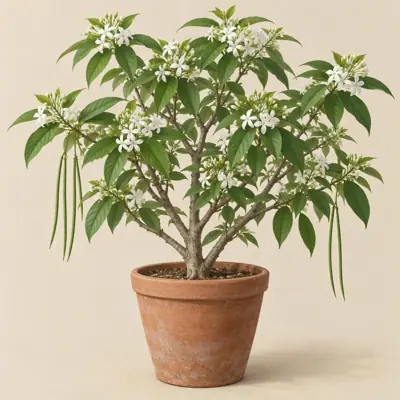
Sources differ on mature height, reporting about 150–150 cm. The leaves are reported to be opposite, ovate to lanceolate, with pointed tips and many fine veins on the undersides. The fragrant, star-shaped flowers are white to off-white, with petals, yellow centers, and may occur in clusters described as terminal or axillary cymes. It can flower continuously throughout the year, while the fruit is reported to consist of paired, slender follicles containing flat seeds with silky hairs.
Light
It is reported to prefer full sun, while indoor cultivation requires bright light.
Watering
It is reported to require regular watering, allowing the surface soil to dry slightly before watering again.
Temperature and dormancy
It is generally described as frost tender and should be kept above freezing.
Propagation
It is reported to be propagated by seed.
Common problems
Wrightia antidysenterica can be confused with names or materials associated with Holarrhena pubescens and Holarrhena antidysenterica. It is reported to be sensitive to frost and should be kept from freezing conditions.
Identification
Wrightia antidysenterica has a compact, evergreen habit, abundant fragrant white star-shaped flowers, and milky sap.
Photos


Sources
- Wikipedia (en): Wrightia antidysenterica — CC BY-SA 4.0 · link
- Wikipedia (es): Wrightia antidysenterica — CC BY-SA 4.0 · link
- Wikipedia (nl): Wrightia antidysenterica — CC BY-SA 4.0 · link
- Useful Tropical/Temperate Plants: Wrightia antidysenterica — CC BY-NC-SA 3.0 (facts only) · link
- Top Tropicals catalog: Wrightia antidysenterica — © Top Tropicals LLC (facts only) · link