
Japanese wisteria (Wisteria floribunda)
Wisteria floribunda is a deciduous, woody climbing vine whose stems twine clockwise around supports. It is perennial and loses its leaves in winter, and it can be very long-lived.
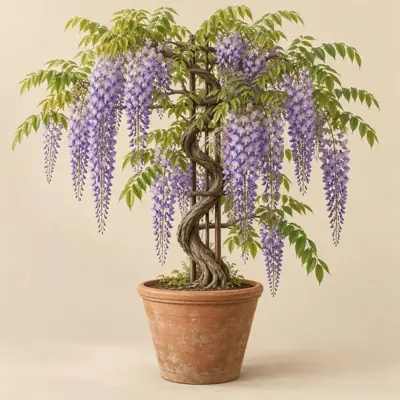
Overview
Wisteria floribunda is a deciduous, woody climbing vine whose stems twine clockwise around supports. It is perennial and loses its leaves in winter, and it can be very long-lived.
Origin and habitat
Sources differ on details of its native range, but describe Wisteria floribunda as native to Japan, principally Honshu, Shikoku, and Kyushu. It occurs in relatively moist environments from temperate to warm regions of Japan, including low mountains, lowland forests, forest edges, countryside, valleys, and areas near streams, and it is also widely cultivated in gardens. It is suited to temperate to warm-temperate conditions and tolerates cold, although flower buds can be damaged by frost in early spring.
Characteristics
Sources differ on mature size, placing height at about 400–1000 cm, while the few available sources report a spread of about 100–150 cm. Growth is moderate to vigorous, producing long, strong climbing shoots; the alternate, glossy green to dark-green leaves are odd-pinnate, with entire, oblong to ovate-oblong leaflets, though sources differ on their dimensions and leaflet counts. Sources differ in details, but describe large, pendent racemes of fragrant pea-shaped flowers opening progressively from the base toward the tip, commonly purple, pale purple, or blue-purple, with white and pink cultivars also occurring; flowering is mainly from spring into early summer. Sources differ in details of the pendent pods, which have velvety short hairs, become hard and split to disperse seeds when mature, and can persist into winter.
Light
Wisteria floribunda grows in full sun to partial sun, with ample sunlight favoring growth and flowering.
Watering
It prefers moist but well-drained soil; insufficient water during active growth can affect flowering, while established plants can tolerate some variation between wetter and drier conditions.
Temperature and dormancy
A single source reports a minimum temperature of about -20 °C, so sources are few. A single source reports an ideal temperature range of about 18–28 °C, so sources are few. It is described as cold hardy, with hardiness classifications reported by both USDA and RHS systems.
Growing medium and mounting
Wisteria floribunda adapts to clay, loam, sand, and chalky soils, with moist but well-drained soil preferred. It tolerates acidic, neutral, or alkaline soil, although alkaline conditions may cause yellowing.
Feeding
Compound fertilizer can be applied periodically beginning in spring, although excessively fertile soil may encourage leaf growth at the expense of flowering.
Propagation
Wisteria floribunda can be propagated by layering, softwood cuttings, hardwood cuttings, grafting, or seed, with cuttings commonly used in home cultivation information.
Common problems
A single source reports that aphids, greenhouse red spider mites, and scale insects may affect the plant. A single source reports susceptibility to honey-fungus-related disease, Phytophthora root rot, and coral spot. Juvenile plants may take many years to flower, and excessive shade or overly fertile soil can also reduce flowering; mature vines grow vigorously and need sturdy support and regular pruning, and the plant is listed as invasive in North Carolina. Flower buds and inflorescences are vulnerable to late frost from early spring through spring, while areas with cool summers may require a warmer, sunnier position.
Identification
Very long, pendent flower racemes and woody vines that twine clockwise are key identifying features of Wisteria floribunda, and multiple sources describe it as having especially long inflorescences within its genus.
Photos


Sources
- Wikipedia (en): Wisteria floribunda — CC BY-SA 4.0 · link
- 維基百科:多花紫藤 — CC BY-SA 4.0 · link
- Wikipedia (ja): フジ (植物) — CC BY-SA 4.0 · link
- Wikipedia (de): Japanische Wisteria — CC BY-SA 4.0 · link
- Wikipedia (fr): Wisteria floribunda — CC BY-SA 4.0 · link
- GBIF descriptions: Checklist of introduced taxa in Cyprus; DAISIE - Inventory of alien invasive species in Europe; The — per dataset · link
- NC State Plant Toolbox: Wisteria floribunda — copyright (facts only) · link
- 農業知識入口網 植物圖鑑: Wisteria floribunda — © MOA, facts only · link
- Useful Tropical/Temperate Plants: Wisteria floribunda — CC BY-NC-SA 3.0 (facts only) · link
- RHS Plants: Wisteria floribunda — © RHS, facts only · link
- USDA PLANTS Database: Wisteria floribunda — Public domain (US Government work) · link