
Mexican Fan Palm (Washingtonia robusta)
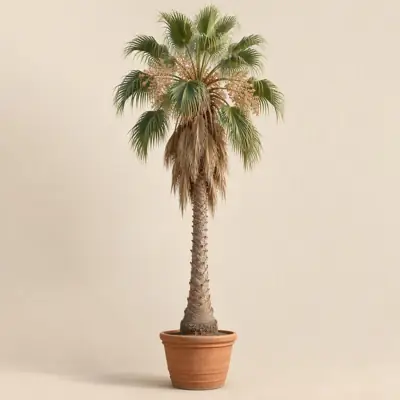
Washingtonia robusta is a perennial, evergreen, large palm tree with a single, upright columnar trunk.
Overview
Washingtonia robusta is a perennial, evergreen, large palm tree with a single, upright columnar trunk.
Origin and habitat
It is native to the Baja California Peninsula and Sonora in Mexico, with its distribution concentrated mainly in the southern Baja California Peninsula and parts of Sonora. Its native habitats include canyons, streams, seasonal waterways, areas near springs, and palm oases in dry regions. It is adapted to warm, sunny, dry to subtropical environments, tolerates heat and drought, and is widely cultivated in tropical and subtropical regions.
Characteristics
Sources differ on mature height, placing it at about 2500–3500 cm, while the few sources for mature spread report about 250–400 cm. It grows rapidly and has large green, fan-shaped palmate leaves divided into linear or drooping segments; younger plants have more threadlike fibers between the segments, which decrease with age, while the petioles have conspicuous spines or teeth and often reddish-brown bases. The flowers are small and numerous on long, branched, drooping or arching inflorescences; sources differ on flower color, describing it as white or pale orange-pink. The fruits are small and nearly spherical, becoming dark to black when mature; sources differ in their descriptions of the fruit.
Light
Full sun is the main light condition, though some sources also report growth from full sun to partial sun.
Watering
It tolerates drought but grows faster with a steady water supply; the growing medium should drain well, as prolonged waterlogging and oxygen-poor soil may quickly kill the plant. In greenhouse cultivation, water moderately during active growth and reduce watering in winter.
Temperature and dormancy
A minimum temperature of about -6 °C is reported, though sources are few. A USDA hardiness zone is also reported, though this information comes from a single source.
Growing medium and mounting
It requires good drainage and can grow in loam. Sources differ on soil conditions, variously describing broad soil tolerance, a preference for alkaline soil, and cultivation in acidic to neutral loam.
Feeding
In greenhouse cultivation, liquid fertilizer is reported to be suitable for regular application during summer.
Propagation
It is reported to be propagated by seed.
Common problems
Scale insects may occur, and greenhouse plants may also have spider mite problems; Boisduval scale is specifically reported as a pest. It is generally reported to have no disease problems. Prolonged waterlogging and oxygen-poor soil may cause rapid decline, cold can damage the leaves, and dead leaves retained as a skirt around the trunk may create a fire risk. It tolerates drought, wind, and salt but is less cold-tolerant than Washingtonia filifera, with cold capable of causing leaf damage.
Identification
Washingtonia robusta has a tall, slender trunk with a distinctly swollen base; compared with Washingtonia filifera, it usually has a thinner trunk, grows faster and taller, has fewer threadlike fibers on the leaves, and has conspicuous petiole spines with petiole bases that are often reddish-brown. Dead leaves may fold downward and remain attached to the trunk, forming a skirt-like appearance.
Photos


Sources
- Wikipedia (en): Washingtonia filifera var. robusta — CC BY-SA 4.0 · link
- Wikipedia (de): Mexikanische Washingtonpalme — CC BY-SA 4.0 · link
- Wikipedia (fr): Washingtonia robusta — CC BY-SA 4.0 · link
- Wikipedia (es): Washingtonia robusta — CC BY-SA 4.0 · link
- GBIF descriptions: Checklist of introduced taxa in Cyprus; Lista de especies de plantas exóticas y trasplantadas de Col — per dataset · link
- NC State Plant Toolbox: Washingtonia robusta — copyright (facts only) · link
- RHS Plants: Washingtonia robusta — © RHS, facts only · link
- USDA PLANTS Database: Washingtonia robusta — Public domain (US Government work) · link