
California fan palm (Washingtonia filifera)
Washingtonia filifera is an evergreen, single-trunked, unbranched, tree-like palm. It is reported to be perennial.
Overview
Washingtonia filifera is an evergreen, single-trunked, unbranched, tree-like palm. It is reported to be perennial.
Origin and habitat
Sources differ on its native range, describing it as southwestern North America, principally including Southern California, western to southwestern Arizona, and Baja California in northwestern Mexico. It occurs in moist sites with reliable water sources in arid regions, often forming pure stands, palm groves, or small colonies along streams, waterways in dry valleys, springs, seeps, and rocky canyons. It is adapted to semiarid, arid to subtropical climates, favors hot and mostly dry summers, can grow in Mediterranean climates, and has some tolerance of cold and drought.
Characteristics
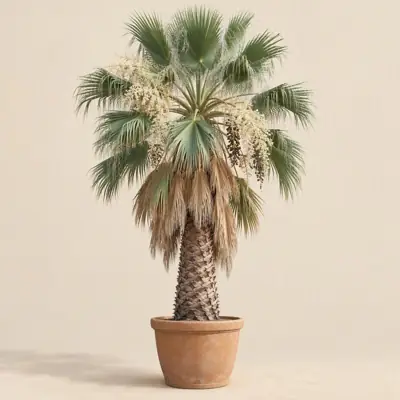
Sources differ on mature height, placing it at about 900–3000 cm, while mature spread is 250–460 cm. Sources differ in describing its growth rate as moderate to fast. The large, palmate, fan-shaped leaves range from gray-green and blue-gray-green to silver-green, with blades deeply divided into many linear segments, conspicuous white threadlike fibers between and along the segments, and long petioles with toothed margins. Sources differ in describing the flowers as white to creamy white, borne on large inflorescences extending beyond the crown, and bisexual; flowering occurs from early summer into summer, while the fruit is generally reported to be an elliptic to ovoid drupe that becomes dark brown to black when mature.
Light
Washingtonia filifera grows in full sun and requires bright light when grown indoors.
Watering
Provide moderate water during the growing period in a well-drained medium and reduce watering in winter; established plants tolerate prolonged drought, while in natural habitats their roots can reach deep groundwater sources.
Humidity and airflow
Washingtonia filifera is generally reported to prefer moderate humidity.
Temperature and dormancy
Sources differ on the minimum temperature, with limited evidence placing it at about -17 °C. It is generally reported for USDA hardiness zones and is generally frost hardy.
Growing medium and mounting
Sources describe the soil differently: fertile, moist but well-drained soil is recommended, natural habitats are also described as including alkaline soil with high pH and some soil-salt tolerance, while RHS cultivation guidance specifies loam that is acidic or neutral.
Feeding
Liquid fertilizer is generally reported for regular application during the summer growing period.
Propagation
Propagation is by seed, with sources also giving specific sowing-temperature and germination-time guidance.
Common problems
In greenhouse cultivation, spider mites are reported as a possible pest, while RHS generally reports no significant disease problems. Persistent dead leaves can form a heavy skirt that may increase combustible material in some environments, and the toothed or spiny petioles require care when handling the plant. It tolerates brief frost and cold, although cold tolerance is affected by wet or dry conditions; it is better suited to dry environments and Mediterranean climates than to humid tropical conditions.
Identification
Washingtonia filifera has a stout single trunk and large gray-green fan-shaped leaves with abundant white threadlike fibers hanging between the leaf segments; if not pruned, dead leaves can persist and form a skirt covering the trunk.
Photos


Sources
- Wikipedia (en): Washingtonia filifera — CC BY-SA 4.0 · link
- 維基百科:丝葵 — CC BY-SA 4.0 · link
- Wikipedia (ja): ワシントンヤシ — CC BY-SA 4.0 · link
- Wikipedia (de): Kalifornische Washingtonpalme — CC BY-SA 4.0 · link
- Wikipedia (fr): Washingtonia filifera — CC BY-SA 4.0 · link
- Wikipedia (es): Washingtonia filifera — CC BY-SA 4.0 · link
- TaiCOL 臺灣物種名錄: Washingtonia filifera — CC BY 4.0 · link
- Useful Tropical/Temperate Plants: Washingtonia filifera — CC BY-NC-SA 3.0 (facts only) · link
- RHS Plants: Washingtonia filifera — © RHS, facts only · link
- USDA PLANTS Database: Washingtonia filifera — Public domain (US Government work) · link
- Top Tropicals catalog: Washingtonia filifera — © Top Tropicals LLC (facts only) · link