
flaming-sword (Vriesea splendens)
Vriesea splendens is an evergreen, epiphytic herbaceous perennial with leaves arranged in a rosette. The parent plant dies after flowering and producing offsets, which continue the plant's growth.
Overview
Vriesea splendens is an evergreen, epiphytic herbaceous perennial with leaves arranged in a rosette. The parent plant dies after flowering and producing offsets, which continue the plant's growth.
Origin and habitat
Sources differ on its native range, describing it as extending from northern South America to Trinidad and Tobago, including the Guianas and eastern Venezuela. It occurs in tropical rainforest and moist, shaded forest environments, growing epiphytically on branches or at the bases of trees. It is reported from tropical, moist forest climates with high humidity.
Characteristics
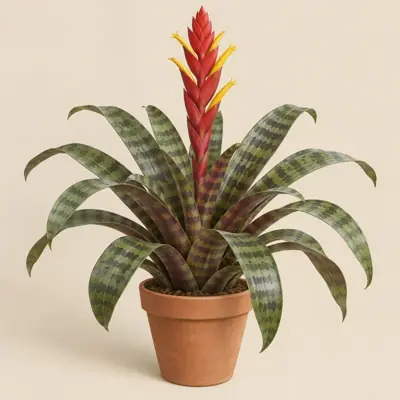
With few sources, mature height is reported at about 50–100 cm. Sources differ, with mature spread reported at about 10–50 cm. The broad, soft leaves are linear to lance-shaped or strap-like, with smooth margins and gray-green to purplish coloring, conspicuous dark green to reddish-brown or brown crossbands, and a rosette arrangement that forms a water-holding central cup. The upright, flattened spike rises from the center of the rosette and bears overlapping, conspicuous bright red to scarlet bracts and yellow tubular flowers.
Light
Provide bright indirect light to partial shade, avoiding strong direct light as the primary growing condition. It is generally suited to bright indirect light.
Watering
Water can be supplied through the central leaf cup; keep the growing medium slightly moist but well drained, allowing its upper portion to dry between waterings, with misting during the growing period and only slight moisture maintained in winter. It is generally watered by filling the central tank. Staying moist is fine.
Humidity and airflow
With few sources, suitable humidity is reported at about 60–80 %.
Temperature and dormancy
With few sources, the cold minimum is reported at about 15.6 °C.
Growing medium and mounting
Use a well-drained bromeliad, potting, or orchid growing medium; RHS lists loam and acidic conditions, and the plant can also be attached to bark or branches. It is generally suited to being mounted.
Feeding
During the growing period, a dilute foliar fertilizer is reported to be applied periodically.
Propagation
Vriesea splendens can be propagated from seed or by separating offsets; seed propagation is less reliable, while separating offsets produced at the base or center of the parent rosette is easier, and RHS recommends separating offsets in spring.
Common problems
Scale insects and mealybugs may occur. Sources differ: leaf spot and bacterial soft rot may occur, while RHS describes disease problems as generally uncommon.
Identification
Vriesea splendens is distinguished by gray-green leaves with conspicuous dark transverse tiger-like bands and, at maturity, an upright red flattened flower spike emerging from the center of the rosette with yellow tubular flowers.
Photos


Sources
- GBIF Backbone: Vriesea splendens (Brongn.) Lem. — CC BY 4.0 · link
- Wikipedia (en): Vriesea splendens — CC BY-SA 4.0 · link
- Wikipedia (fr): Vriesea splendens — CC BY-SA 4.0 · link
- GBIF descriptions: Lista de especies de plantas exóticas y trasplantadas de Colombia; Catálogo de Plantas y Líquenes de — per dataset · link
- NC State Plant Toolbox: Vriesea splendens — copyright (facts only) · link
- RHS Plants: Vriesea splendens — © RHS, facts only · link