
Samurai orchid (Vanda falcata)
Vanda falcata is an evergreen, perennial, monopodial epiphytic orchid that may occasionally grow on rocks and can form clumps.
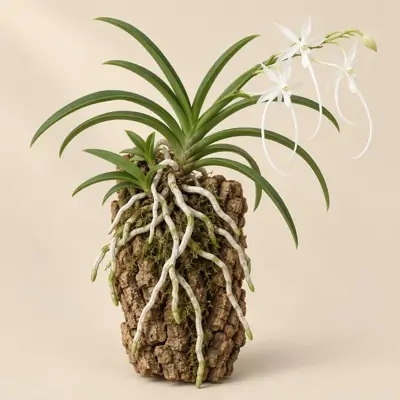
Overview
Vanda falcata is an evergreen, perennial, monopodial epiphytic orchid that may occasionally grow on rocks and can form clumps.
Origin and habitat
Sources differ on its native distribution, describing a range that includes Japan, the Korean Peninsula, and China, with Japanese distribution accounts extending westward from the southern Kanto region and one source explicitly including the Ryukyu Islands. It mainly grows on the branches and trunks of deciduous or evergreen trees, but can also occur on rock faces and occasionally artificial stone walls; its roots favor exposed, well-ventilated conditions. One source reports warm days and nights with high humidity in its native habitat during summer, somewhat lower humidity in other seasons, and greater rainfall during the early-summer rainy season.
Characteristics
Sources differ on mature height, placing it at about 8–12 cm, while the few available sources put mature spread at about 10–50 cm. The leaves are narrow, slightly sickle-shaped and leathery, with sheathing bases, and are commonly arranged in two ranks. Sources differ in their descriptions of flowering, but the typical flowers are fragrant and white, with a conspicuously curved spur; cultivated forms also vary in flower color and form. Sources differ on the flowering period, describing it mainly in early summer while some extend it through autumn or, rarely, later; one source also reports slow growth.
Light
Vanda falcata does well in bright, indirect light to bright partial shade with good ventilation; morning sun is beneficial, and stronger light can be accepted in winter. Its light level is characterized as medium light.
Watering
Water regularly during active growth while allowing rapid drainage and alternating wetter and drier conditions; mounted plants can be watered more frequently, while winter watering should be substantially reduced without allowing prolonged complete dryness. It is generally recommended to let it dry between waterings.
Humidity and airflow
It prefers high humidity, with a stated range of 75–85 %. It needs good airflow.
Temperature and dormancy
The few available sources place the ideal temperature at about 18–31 °C. It is generally characterized as cool-growing.
Growing medium and mounting
Use well-draining, well-aerated orchid bark, coarse bark, or sphagnum moss, or grow it mounted on cork, tree-fern material, or driftwood. It is epiphytic and has aerial roots with velamen.
Feeding
It is reported to have low fertilizer requirements; when fertilizer is used, feeding is described during periods of active growth and reduced or stopped during winter.
Propagation
Mature plants can be propagated from side shoots or by division, with divisions retaining several roots; seed propagation requires a controlled laboratory environment.
Common problems
Scale insects and mealybugs may occur, while thrips may damage flowers and developing buds. One source reports that disease is generally uncommon, although poor airflow may contribute to bacterial or fungal rot. Poor ventilation combined with high humidity can lead to rot; excess winter moisture increases this risk, while prolonged excessive dryness is also unsuitable. It is generally recommended to shelter the plant from northerly winds and reduce moisture in winter, while hot conditions call for greater humidity, watering, airflow, and shade.
Identification
Vanda falcata is distinguished by its small, monopodial growth, slender rigid sickle-shaped leaves, thick white aerial roots, and fragrant flowers with a long curved spur.
Photos


Sources
- Wikipedia (en): Vanda falcata — CC BY-SA 4.0 · link
- Wikipedia (ja): フウラン — CC BY-SA 4.0 · link
- RHS Plants: Vanda falcata — © RHS, facts only · link
- AOS culture sheet: Vanda (genus-level) — © American Orchid Society, facts only · link
- NHK みんなの趣味の園芸 植物図鑑: Vanda (genus-level) — © NHK出版, facts only · link
- NC State Plant Toolbox: Vanda (genus-level) — copyright (facts only) · link
- IOSPE PHOTOS (www.orchidspecies.com) — facts only (§12) · link