
Pondo Bladderwort (Utricularia sandersonii)
Utricularia sandersonii is a terrestrial to lithophytic carnivorous plant that can form dense mats or carpet-like colonies. It is an evergreen perennial.
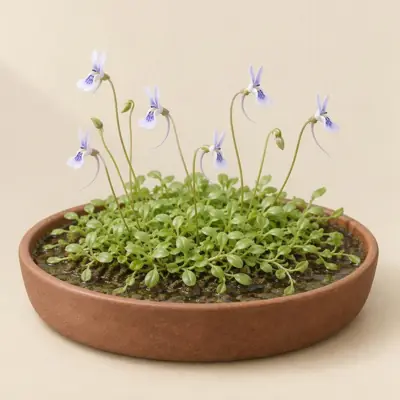
Overview
Utricularia sandersonii is a terrestrial to lithophytic carnivorous plant that can form dense mats or carpet-like colonies. It is an evergreen perennial.
Origin and habitat
It is endemic to South Africa and occurs in eastern South Africa from KwaZulu-Natal to the Eastern Cape, including the historical Transkei region. It grows on wet rock surfaces, often on steep or nearly vertical rock faces, among rocks, and in crevices. It is native to subtropical environments in eastern South Africa, where the climate is reported to have milder winters and hotter summers.
Characteristics
Sources differ on mature size, placing height at about 10–50 cm and spread at about 10–50 cm. It readily expands into dense colonies, with relatively rapid vegetative propagation. The foliage is small; commercial sources describe rounded leaves forming dense, low clusters, while cultivated plants may also show small, grass-like above-ground structures. The flowers are white with pale blue to pale purple markings, with a long forward-curving spur and prominent upper lobes resembling rabbit ears. Cultivation sources describe a flowering period extending across part of the year, with prolonged flowering possible under suitable conditions.
Light
Sources differ on light conditions, supporting settings from bright light to full sun; grow lights may be used indoors, so the guidance should not be interpreted as a single fixed light condition. Full sun is also supported as a light need.
Watering
Keep the growing medium continuously and evenly moist and do not allow it to dry out. Use pure water only (rain, RO or distilled), with tray (bottom) watering being compatible.
Humidity and airflow
It is reported to prefer high humidity, with the few available sources indicating about 80–100 %.
Temperature and dormancy
A limited source reports an ideal range of about 15–25 °C. Sources differ on the temperature limits, with the few available sources indicating a minimum of about 1 °C and a maximum of about 30 °C. It is reported as RHS H2 and frost tender; keep above freezing. It is reported to have no dormancy.
Growing medium and mounting
Suitable media include a peat-substitute mix intended for carnivorous plants or a mixture of peat moss and perlite; genus-level cultivation information also describes terrestrial bladderworts growing in pure sand kept continuously moist. Peat with perlite is also reported as a substrate type.
Feeding
It is reported to be grown without fertilizer. Tiny bladder-like traps on the underground stems capture microorganisms.
Propagation
It can be propagated by division, seed, or plant fragments, with vegetative propagation from fragments described as fast and easy. The seeds require light for germination.
Common problems
It is generally reported to have few conspicuous pest or disease problems. The medium should not be allowed to dry during cultivation, while rapid vegetative propagation can create a risk of escape or invasion in suitable environments. It has some cold tolerance but cannot withstand freezing and is suited to a sheltered position.
Identification
Its most conspicuous feature is its white, rabbit-ear-like flowers. The bladder traps occur near the underground stems and capture microorganisms, while the mainly visible above-ground parts are not responsible for trapping prey.
Photos


Sources
- Wikipedia (en): Utricularia sandersonii — CC BY-SA 4.0 · link
- 維基百科:小白兔狸藻 — CC BY-SA 4.0 · link
- Wikipedia (de): Utricularia sandersonii — CC BY-SA 4.0 · link
- Wikipedia (es): Utricularia sandersonii — CC BY-SA 4.0 · link
- RHS Plants: Utricularia sandersonii — © RHS, facts only · link
- NC State Plant Toolbox: Utricularia (genus-level) — copyright (facts only) · link
- Bladderwort 'Utricularia sandersonii' (www.araflora.com) — facts only (§12) · link
- Utricularia sandersonii Blue – California Carnivores (californiacarnivores.com) — facts only (§12) · link