Cape Bladderwort (Utricularia bisquamata)
Utricularia bisquamata is reported to be a small, terrestrial, carnivorous herb with creeping growth and trapping bladders. It is reported to be annual.
Overview
Utricularia bisquamata is reported to be a small, terrestrial, carnivorous herb with creeping growth and trapping bladders. It is reported to be annual.
Origin and habitat
Sources agree that it is native to southern Africa, including Angola, Namibia, South Africa and Madagascar; sources differ on whether Lesotho and Eswatini are also included. It is reported to grow terrestrially in moist, open habitats, often among moss near streams or wet depressions and in sandy, peaty or acidic bog soils; it has also been recorded on sphagnum mats over rocks. Sources describe its native habitats as moist environments in southern Africa, with some populations occurring in South African fynbos vegetation.
Characteristics
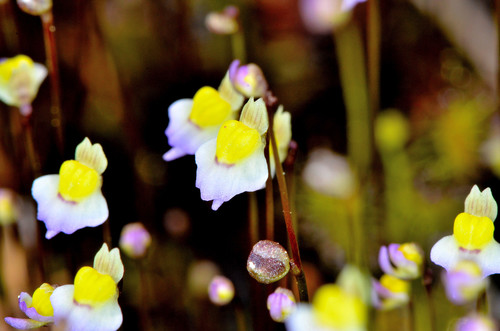
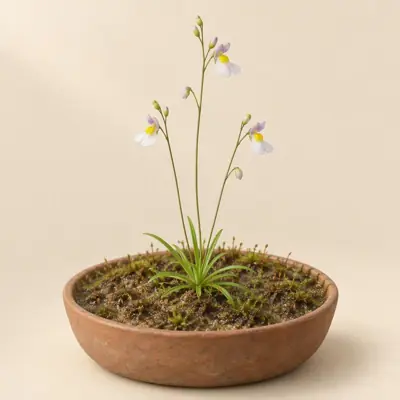
Few sources indicate a mature height of about 0–12 cm. The leaves are reported to form a rosette and to be bright green, narrow and blunt-tipped. The flowers are reported to occur singly or in small groups on slender stalks, with a two-lipped corolla that may be white, pale purple or occasionally yellow and often bears yellow markings of varying size. Flowering is reported to occur during part of the year, with the recorded period for Angolan populations differing from the general flowering period.
Light
Full sun is reported as the light preference for most Utricularia species, but the source does not separately confirm this for Utricularia bisquamata.
Watering
It is reported to require a moist environment, consistent with wild plants occurring by streams, in wet depressions, among wet moss and in boggy soils; keep wet. Pure water only (rain, RO or distilled) is reported to be suitable.
Growing medium and mounting
A moist sandy or peaty growing medium is reported; wild habitats also include acidic bog soils and sphagnum mats. Sand with peat is reported as a substrate type.
Feeding
Utricularia is reported to feed mainly on rotifers and mosquito larvae.
Propagation
Utricularia bisquamata is reported to be propagated from seed, with seeds readily germinating in cultivation.
Common problems
Information for Utricularia generally does not report serious pest or disease problems. Some Utricularia species are reported to spread vigorously and to be sensitive to chemicals used in tap-water treatment.
Identification
Sources describe small, transparent trapping bladders with tentacle-like appendages above and below the entrance, while accounts differ in their details of the bladders. The corolla often has conspicuous yellow markings.
Photos