
Butter Bush (Tylecodon paniculatus)
Tylecodon paniculatus is a stout perennial succulent shrub to small tree with a thick, tuber-like main trunk. It is perennial, growing in winter and becoming deciduous and dormant in summer, although sources describe this differently.
Overview
Tylecodon paniculatus is a stout perennial succulent shrub to small tree with a thick, tuber-like main trunk. It is perennial, growing in winter and becoming deciduous and dormant in summer, although sources describe this differently.
Origin and habitat
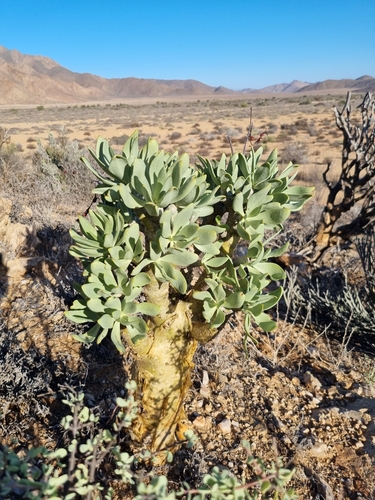
Tylecodon paniculatus is native from Namibia to southwestern South Africa, including the Northern Cape, Namaqualand, the Western Cape coast, and parts of the Little Karoo and Great Karoo. It is often found on rocky slopes in the Succulent Karoo, and can also grow in sheltered ravines or valleys and in coastal quartz-bearing sandy loam. Its habitat has a dry, winter-rainfall climate, with the main growth period corresponding to winter rains and deciduous dormancy during hot, dry summers.
Characteristics
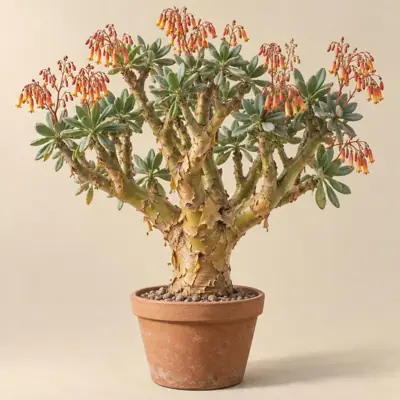
Sources differ on mature size, placing height at about 150–300 cm and, from few sources, spread at about 0–50.8 cm. It is generally reported to grow very slowly and develops a swollen stem; the stout trunk can become notably broad. The thick, succulent, stalkless leaves are concentrated in a spiral arrangement at branch tips, are mainly obovate to paddle-shaped and green to yellow-green, with broadly pointed to rounded tips and wedge-shaped bases; they are shed in summer, although sources differ in their descriptions. The flowers occur in slender, branched terminal inflorescences with flower stalks often bright to dark red; sources differ in describing the tubular to urn-shaped flowers and their yellow-orange, orange-red, dark red, or purplish-red coloration, while flowering is mainly in summer and the erect capsules are reported to contain small pale-brown seeds released in autumn.
Light
Sources differ, describing cultivation in full sun as well as growth and flowering in partial sun to bright shade.
Watering
During its growth period from late summer to early spring, water after the growing medium has become nearly dry; during dormancy from late spring through summer, withhold water or keep it dry. While in leaf, it is generally reported to be watered when the mix has dried, while water should be withheld while it is leafless. Few sources report winter watering at about every 14 days.
Temperature and dormancy
Sources differ on the minimum temperature, with few sources giving about 5 °C. It is frost tender and should be kept above freezing; another specialist source gives a cold minimum of about 5 °C, but sources are few. It drops its leaves and goes dormant, with heat generally reported to trigger dormancy. It is reported to have high heat tolerance, and a single source places it in the stated USDA hardiness range.
Growing medium and mounting
Tylecodon paniculatus needs a very fast-draining mix; sandy soil or sandy loam can be used. For containers, the medium can combine mature compost or fine bark with drainage materials such as river sand, silica sand, or pumice, or use a well-drained cactus mix.
Feeding
It is generally reported to have low fertilizer requirements; container-grown plants may receive a moderate amount of diluted high-potassium fertilizer during the growing season or a slow-release fertilizer.
Propagation
It is generally reported to be propagated from seed, with mature seed sown as soon as it can be removed from the capsule, or by cuttings in late autumn. Seedlings are generally reported to become ready for transplanting after an initial period of growth. Cuttings are also generally reported as a propagation method.
Common problems
It should be kept relatively dry during dormancy, and leaves can drop readily under cool conditions. Frost should be avoided, and winter conditions are recommended to remain relatively warm. It is reported to be susceptible to mealybugs.
Identification
Tylecodon paniculatus has a very stout main trunk that becomes greenish yellow to olive green when mature, with thin, papery, peeling bark; its short branches bear conspicuous leaf scars, thick leaves cluster at the branch tips, and red branched inflorescences emerge in summer.
Photos


Sources
- Wikipedia (en): Tylecodon paniculatus — CC BY-SA 4.0 · link
- Wikipedia (de): Tylecodon paniculatus — CC BY-SA 4.0 · link
- LLIFLE Encyclopedia of living forms: Tylecodon paniculatus — CC BY-SA · link
- The Succulent Plant Page: Tylecodon (genus-level) — © R.J. Hodgkiss, facts only · link
- Tylecodon paniculatus | Butter Tree | plant lust (plantlust.com) — facts only (§12) · link
- PUKUBOOK: Tylecodon paniculatus — CC BY-NC (facts only) · link
- Tylecodon - Crassulaceae (succulent-plant.com) — facts only (§12) · link