
inchplant (Tradescantia zebrina)
Tradescantia zebrina is a low-growing herb with creeping to trailing growth that can form dense ground cover or colonies; stem nodes can root when they contact suitably moist growing medium. It is an evergreen perennial herb and can also be grown as an annual in colder regions.
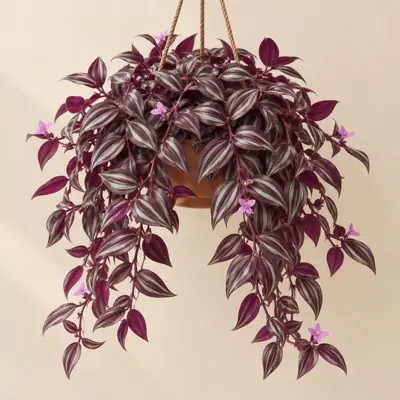
Overview
Tradescantia zebrina is a low-growing herb with creeping to trailing growth that can form dense ground cover or colonies; stem nodes can root when they contact suitably moist growing medium. It is an evergreen perennial herb and can also be grown as an annual in colder regions.
Origin and habitat
Sources differ on its native range: it is mainly described as native from Mexico to Central America, with some accounts extending the range to Colombia; it is now cultivated and naturalized in many tropical and subtropical regions worldwide. It is reported to occur in shrubland, forest floors, and on rock surfaces in moist to rainforest environments, as well as in shady, moist sites such as stream sides and roadsides; escaped plants may also occur in woodland near human habitation and on coastal forest floors. It prefers warm conditions and can be used as outdoor ground cover where winters are warm, while in colder regions it is more often grown indoors or as an annual.
Characteristics
Sources differ on mature height, placing it at about 10–50 cm, while the few available sources report a mature spread of about 10–50 cm. It grows rapidly, with creeping stems readily rooting at the nodes and spreading outward. The slightly fleshy leaves are generally ovate to ovate-oblong with pointed tips, green to purple upper surfaces marked by longitudinal silver stripes, and purple to deep magenta undersides; the pink to purple flowers have petals and stamens and may form small terminal flower clusters, with scattered flowering possible throughout the year. The fruit is reported to be a capsule containing gray-brown seeds.
Light
It can grow in full sun to partial sun, while bright filtered light is more suitable indoors; ample light supports leaf coloration, but intense direct sunlight in some hot regions may fade the color or markings.
Watering
Water regularly during active growth and keep the growing medium moderately moist but well drained, allowing the soil to dry slightly between waterings; reduce watering in autumn and winter or during winter.
Temperature and dormancy
The few available sources report a minimum temperature of about 12 °C. Sources differ on the ideal temperature range, placing it at about 13–30 °C. It is reported to have a USDA hardiness-zone range.
Growing medium and mounting
It grows in moist, fertile, well-drained soil and can use loamy or sandy soil across acidic, neutral, or alkaline conditions.
Feeding
For indoor cultivation, a balanced liquid fertilizer is reported to be suitable during active growth on a regular monthly schedule.
Propagation
It can be propagated mainly from stem or softwood cuttings, which can root in growing medium or water; stem nodes also readily root naturally when they contact moist growing medium.
Common problems
In insufficient light, stems may lose their lower leaves and the remaining leaves may become paler; prolonged intense sunlight can also fade their markings or color. It is unsuitable for overwintering outdoors where frost occurs and should be kept in a bright indoor location in frosty regions; excessively strong sunlight in hot regions may fade the leaf color.
Identification
Its most conspicuous features are its creeping growth and the strong contrast between longitudinal silver stripes on the upper leaf surface and the purple underside. Prolonged intense sunlight may fade the characteristic markings and make the leaves appear more uniformly purple.
Photos


Sources
- Wikipedia (en): Tradescantia zebrina — CC BY-SA 4.0 · link
- 維基百科:吊竹梅 — CC BY-SA 4.0 · link
- Wikipedia (ja): シマムラサキツユクサ — CC BY-SA 4.0 · link
- Wikipedia (de): Zebra-Ampelkraut — CC BY-SA 4.0 · link
- Wikipedia (fr): Tradescantia zebrina — CC BY-SA 4.0 · link
- Wikipedia (es): Tradescantia zebrina — CC BY-SA 4.0 · link
- GBIF descriptions: The checklist of alien seed plants of D.R. Congo, based on evidence from herbarium collections; List — per dataset · link
- NC State Plant Toolbox: Tradescantia zebrina — copyright (facts only) · link
- RHS Plants: Tradescantia zebrina — © RHS, facts only · link
- USDA PLANTS Database: Tradescantia zebrina — Public domain (US Government work) · link