
boatlily (Tradescantia spathacea)
Sources describe the habit somewhat differently, but Tradescantia spathacea is a perennial evergreen herb with a short stem, densely arranged rosette-forming leaves, and a tendency to form clumps.
Overview
Sources describe the habit somewhat differently, but Tradescantia spathacea is a perennial evergreen herb with a short stem, densely arranged rosette-forming leaves, and a tendency to form clumps.
Origin and habitat
Sources differ on its native range: the core range is described as southern Mexico, Belize, and Guatemala, while some sources also include the West Indies or Antilles. It is reported from dry forests of Mexico, Central America, and the Antilles, in tropical to subtropical climates.
Characteristics
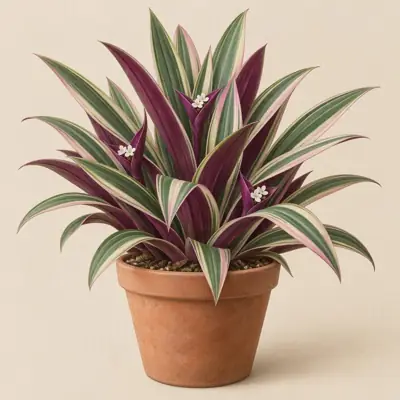
Sources differ on mature height, placing it at about 15–50 cm, while mature spread is 10–60.96 cm. The sessile or nearly sessile, slightly fleshy leaves are densely arranged in rosettes and range from lance-shaped and oblong-lance-shaped to strap-shaped; the typical form has dark green upper surfaces and purple to wine-purple undersides, while some cultivated forms have longitudinal striping. Small white flowers are clustered in axillary inflorescences and enclosed by purple to wine-colored, boat- or shell-shaped bracts. Sources differ on flowering season, with flowering in cultivation potentially occurring year-round; the fruit is reported to mature within the boat-shaped bracts, which dry as it matures and may remain on the plant for a long time.
Light
Tradescantia spathacea accepts full sun to partial sun; indoors, bright filtered or bright indirect light is suitable, while intense direct sunlight may scorch the leaves.
Watering
Water moderately during active growth, allowing the surface of the potting medium to dry before watering again; water needs are higher in summer and should be reduced in winter, and poorly drained conditions should be avoided.
Temperature and dormancy
A single source reports a minimum temperature of about 8 °C, so sources are few. It is generally assigned a USDA hardiness range, though the available claim does not support stating its numeric zones.
Growing medium and mounting
Use a well-drained medium, such as sandy or loamy soil, across acidic, neutral, or alkaline conditions; fertile, well-drained soil or peat-free houseplant potting medium is also recommended.
Feeding
Liquid fertilizer is generally applied monthly during active growth.
Propagation
Tradescantia spathacea can be propagated by seed, division, or stem-tip cuttings.
Common problems
Insufficient light may cause leggy growth and purple foliage to become greener, while intense direct sunlight may scorch the leaves. Cold tolerance is limited, and watering should be reduced during low winter temperatures.
Identification
Distinctive features include rosettes of lance-shaped leaves with typically purple undersides and purple boat-shaped bracts enclosing small white flowers.
Photos


Sources
- Wikipedia (en): Tradescantia spathacea — CC BY-SA 4.0 · link
- 維基百科:紫背万年青 — CC BY-SA 4.0 · link
- Wikipedia (ja): ムラサキオモト — CC BY-SA 4.0 · link
- Wikipedia (de): Purpurblättrige Dreimasterblume — CC BY-SA 4.0 · link
- Wikipedia (fr): Tradescantia spathacea — CC BY-SA 4.0 · link
- Wikipedia (es): Tradescantia spathacea — CC BY-SA 4.0 · link
- NC State Plant Toolbox: Tradescantia spathacea — copyright (facts only) · link
- Useful Tropical/Temperate Plants: Tradescantia spathacea — CC BY-NC-SA 3.0 (facts only) · link
- RHS Plants: Tradescantia spathacea — © RHS, facts only · link
- USDA PLANTS Database: Tradescantia spathacea — Public domain (US Government work) · link