
small-leaf spiderwort (Tradescantia fluminensis)
Tradescantia fluminensis is an evergreen, creeping to trailing perennial herb that can form ground cover; its stems begin somewhat upright before falling over, and nodes touching the soil can root. It is perennial.
Overview
Tradescantia fluminensis is an evergreen, creeping to trailing perennial herb that can form ground cover; its stems begin somewhat upright before falling over, and nodes touching the soil can root. It is perennial.
Origin and habitat
Tradescantia fluminensis is native to South America, with more detailed sources placing its native range from southern to eastern Brazil through Paraguay and Uruguay to northern Argentina. It can grow on the ground, on rocks, or as an epiphyte, and can form dense ground cover in low-light settings such as beneath forest canopies. It is reported to escape cultivation in tropical and subtropical regions; it tolerates shade, while cold, frost, and snow can suppress growth.
Characteristics
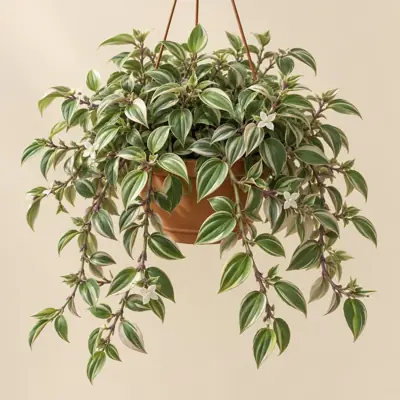
Sources differ on mature height, reporting about 10–60 cm, while a single source reports a mature spread of about 10–50 cm. Sources differ in their descriptions of the leaves: they are alternate to two-ranked alternate, ovate, broadly ovate, or elliptic, with pointed tips and entire or finely hairy margins, and are slightly fleshy; typical plants have medium- to dark-green upper leaf surfaces, while horticultural sources also describe variegated forms with pale pink and creamy-white stripes and leaves that may be purple beneath. The small white flowers have petals and may occur at stem tips or in leaf axils; sources also describe their size. Sources differ on flowering, describing summer flowering or intermittent flowering through the year in cultivation; fruit is generally reported to be a small, many-seeded capsule with brown seeds.
Light
Bright indirect light or partial shade is suitable, and the plant tolerates deep shade; it can accept full sun, but strong afternoon sunlight should be avoided because it can scorch the leaves, while variegated plants are suited to bright filtered light.
Watering
It prefers moist but well-drained soil or potting medium; prolonged dryness weakens growth, although its fleshy tissues can help it endure a period of drought and growth can resume when conditions improve.
Growing medium and mounting
It prefers a moist but well-drained medium; the RHS specifies loam, peat-substitute potting medium, and neutral pH.
Propagation
It is readily propagated by stem cuttings, with softwood cuttings from stem tips taken in spring or summer; stem nodes touching moist soil can also root on their own.
Common problems
Possible pests include spider mites, mealybugs, aphids, weevils, thrips, slugs, snails, and some caterpillars, while disease problems are generally reported to be uncommon. Variegated plants may produce solid-green reverted shoots that can gradually overtake variegated growth if not removed, and excessive light may scorch the leaves. The plant is sensitive to cold, frost, and snow, with low temperatures suppressing growth; strong direct afternoon sunlight can also scorch the leaves.
Identification
The soft, slightly fleshy trailing stems root readily at the nodes, and the flowers are white with petals; variegated horticultural forms have creamy-white, pale pink, and purple tones in their foliage.
Photos


Sources
- Wikipedia (en): Tradescantia fluminensis — CC BY-SA 4.0 · link
- Wikipedia (de): Rio-Dreimasterblume — CC BY-SA 4.0 · link
- Wikipedia (fr): Tradescantia fluminensis — CC BY-SA 4.0 · link
- Wikipedia (es): Tradescantia fluminensis — CC BY-SA 4.0 · link
- GBIF descriptions: Manual of the Alien Plants of Belgium; Checklist of introduced taxa in Cyprus; Wandering throughout — per dataset · link
- NC State Plant Toolbox: Tradescantia fluminensis — copyright (facts only) · link
- RHS Plants: Tradescantia fluminensis — © RHS, facts only · link
- USDA PLANTS Database: Tradescantia fluminensis — Public domain (US Government work) · link