
Chusan Palm (Trachycarpus fortunei)
Trachycarpus fortunei is a perennial evergreen fan palm with an upright, usually unbranched single trunk.
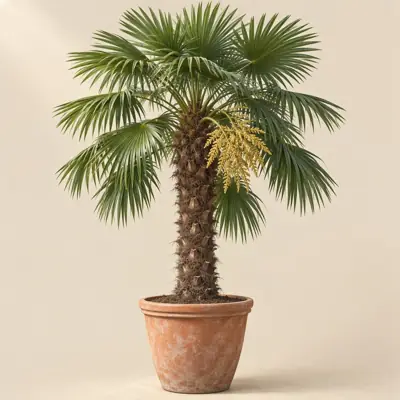
Overview
Trachycarpus fortunei is a perennial evergreen fan palm with an upright, usually unbranched single trunk.
Origin and habitat
Its core native range is in China and extends into the Himalayan region, northern India, and northern Myanmar, although sources differ on the exact natural range because of its long history of cultivation in China and Japan. It occurs in montane forests, including montane oak forests and subtropical and temperate mountain forests in China. It is adapted to temperate to subtropical climates, especially cool, moist summers and cold winters, and can be cultivated in warm-temperate and some cooler regions.
Characteristics
Sources differ on mature height, placing it at about 1200–2000 cm. A single source reports a mature spread of about 150–250 cm, so sources are few. Growth is generally reported to be slow; the deeply divided, palmate fan leaves are concentrated at the top of the trunk and are usually dark green, with relatively long petioles bearing small spines or teeth along their margins or sides, and some plants have drooping leaflet tips. Sources differ in descriptions of its reproductive features: plants are dioecious, with many small flowers on large branched inflorescences, male flowers yellow and female flowers green to yellowish; flowering occurs from late spring into summer, while the small drupes mature in autumn, changing from yellow to blue-black or black-purple and being described by most sources as kidney- or bean-shaped.
Light
It grows in full sun to partial shade, while a more sheltered position with some shade and protection from strong wind can also help keep the leaves intact.
Watering
It prefers moist but well-drained soil; watering can be regular to moderate, allowing the surface soil to dry slightly before watering again.
Temperature and dormancy
Sources differ on minimum temperature tolerance, with reports around -18 °C. It is frost hardy. A single source generally places its hardiness in the USDA zone range given for the species.
Growing medium and mounting
It grows in well-drained soil, including loamy, sandy, or chalky soils under acidic, neutral, or alkaline conditions; another source also recommends fertile, moist, well-drained soil.
Propagation
It is reported to be propagated from seed, and because plants are dioecious, both male and female plants are needed for seed production.
Common problems
Scale insects, including Boisduval scale, are reported as possible pests, while root rot, yellowing disease, and leaf-spot problems are also reported. Strong wind is reported to tear the leaves, usually affecting appearance rather than being fatal. Mature plants are strongly cold tolerant, but young plants are less tolerant of low temperatures; strong winds or cold, dry winds can also damage the leaves, and some sources indicate that severe water shortage and extreme heat are unfavorable.
Identification
Distinctive features include a crown of fan-shaped leaves atop an upright single trunk and coarse brown to gray-brown leaf-sheath fibers that remain attached to the trunk for a long time; mature plants are also noted for strong cold tolerance.
Photos


Sources
- Wikipedia (en): Trachycarpus fortunei — CC BY-SA 4.0 · link
- 維基百科:棕榈 — CC BY-SA 4.0 · link
- Wikipedia (de): Chinesische Hanfpalme — CC BY-SA 4.0 · link
- Wikipedia (fr): Trachycarpus fortunei — CC BY-SA 4.0 · link
- Wikipedia (es): Trachycarpus fortunei — CC BY-SA 4.0 · link
- GBIF descriptions: Manual of the Alien Plants of Belgium; Checklist of introduced taxa in Cyprus; Lista de especies de — per dataset · link
- NC State Plant Toolbox: Trachycarpus fortunei — copyright (facts only) · link
- Useful Tropical/Temperate Plants: Trachycarpus fortunei — CC BY-NC-SA 3.0 (facts only) · link
- RHS Plants: Trachycarpus fortunei — © RHS, facts only · link
- Top Tropicals catalog: Trachycarpus fortunei — © Top Tropicals LLC (facts only) · link