
Shirley Temple Airplant (Tillandsia xerographica)
Tillandsia xerographica is an evergreen perennial herb, primarily an epiphyte with a rosette growth form, though it is also recorded growing on rocks in the wild. An individual plant typically flowers only once in its lifetime and can produce offsets from the leaf bases after flowering and seed maturation.
Watch: 25 Air Plants: No Soil, Seriously
Overview
Tillandsia xerographica is an evergreen perennial herb, primarily an epiphyte with a rosette growth form, though it is also recorded growing on rocks in the wild. An individual plant typically flowers only once in its lifetime and can produce offsets from the leaf bases after flowering and seed maturation.
Origin and habitat
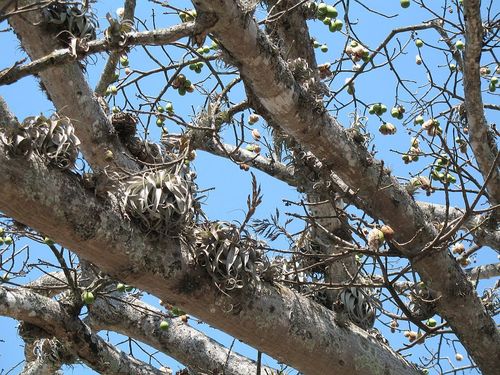
Sources differ on its native range, with accounts including southern Mexico, Guatemala, El Salvador, and Honduras. It occurs mainly in dry forests, drier forests, and thorn scrub, often growing epiphytically on higher, more strongly lit tree branches, with records also of growth on rocks. Its native environment is reported to be relatively dry and tropical to subtropical.
Characteristics
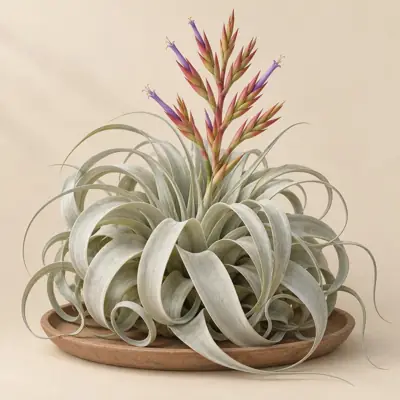
Mature plants can reach 50–100 cm in height and 50–100 cm in spread, and growth is slow. The densely arranged leaves form a large rosette; they are broad at the base and taper toward the tip, range from silvery gray to greenish silver, have a dense covering of fine scales, and mature leaves often curl outward with a wavy form. The upright inflorescence is densely branched, with slender tubular flowers whose petals range from pale purple to red or purple and bracts that can be greenish yellow, orange-red, or rose-red; its ornamental display can persist for months.
Light
Sources differ in their descriptions of light conditions: cultivation favors bright indirect light or partial sun with good ventilation, while plants in the native habitat can grow high in trees under very strong light. Bright indirect light is suitable.
Watering
Sources differ on watering details, but the plant can be soaked periodically and should be thoroughly drained with good ventilation afterward, avoiding prolonged water retention in the center of the rosette; it tolerates some drought. Use a soak, then let dry approach. It is reported to need to dry quickly after watering.
Humidity and airflow
It is reported to prefer moderate humidity and need good airflow. Good airflow is needed.
Temperature and dormancy
With few sources, an ideal temperature range of about 22–28 °C is reported. With few sources, reported temperature limits are about 1 °C at the low end and about 40 °C at the high end. It is frost tender; keep above freezing. Hardiness classifications are given for both USDA and RHS systems.
Growing medium and mounting
Ordinary potting soil is unnecessary; the plant can be secured to a support, wood, or another attachment surface. It is suited to being mounted.
Feeding
Diluted liquid fertilizer or foliar fertilizer can be used occasionally.
Propagation
Propagation can be by seed or by separating offsets formed after the parent plant flowers; offsets should be allowed to reach a substantial size relative to the parent before separation.
Common problems
Sources differ on pest problems: pests are generally described as uncommon, though aphids and mealybugs may occur. Sources differ on disease problems: they are generally uncommon, but poor ventilation or prolonged water retention can be associated with fungal problems or rotting at the center of the rosette. Water remaining in the center of the rosette after watering without drying quickly can cause crown rot. As a tropical plant, it does not tolerate frost or freezing and needs protection or to be moved indoors when the weather turns cold.
Identification
Tillandsia xerographica is distinguished by its large, sculptural rosette, broad curled silvery-gray leaves, and tall, densely branched inflorescence with red and yellow-green bracts.
Photos


Sources
- Wikipedia (en): Tillandsia xerographica — CC BY-SA 4.0 · link
- Wikipedia (ja): チランジア・キセログラフィカ — CC BY-SA 4.0 · link
- Wikipedia (es): Tillandsia xerographica — CC BY-SA 4.0 · link
- NC State Plant Toolbox: Tillandsia xerographica — copyright (facts only) · link
- RHS Plants: Tillandsia xerographica — © RHS, facts only · link
- Rainforest Flora care guide: Tillandsia (group-level) — © Rainforest Flora, facts only · link
- NHK みんなの趣味の園芸 植物図鑑: Tillandsia (genus-level) — © NHK出版, facts only · link
- Top Tropicals catalog: Tillandsia xerographica — © Top Tropicals LLC (facts only) · link