
Spanish moss (Tillandsia usneoides)
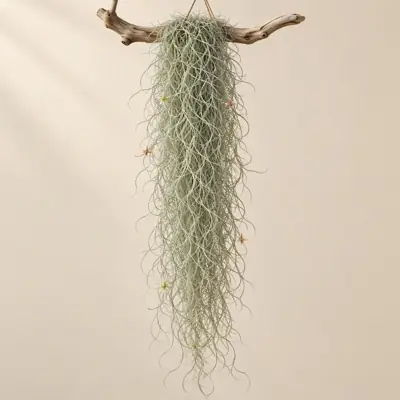
Tillandsia usneoides is a hanging epiphytic perennial herb that typically lacks roots when mature and forms trailing masses from slender stems. It is an evergreen perennial.
Watch: 25 Air Plants: No Soil, Seriously
Overview
Tillandsia usneoides is a hanging epiphytic perennial herb that typically lacks roots when mature and forms trailing masses from slender stems. It is an evergreen perennial.
Origin and habitat
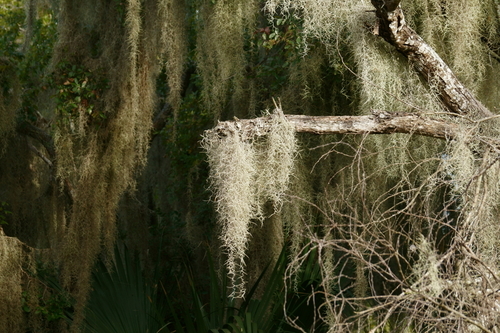
Sources differ somewhat on its native range, describing Tillandsia usneoides as native across tropical to subtropical parts of the Americas, from the southern United States through Mexico, Central America and the Caribbean into South America, with multiple sources extending the range to Argentina. It grows mainly as an epiphyte on tree branches and other elevated supports, occurring in settings including lowlands, swamps, wetlands, moist pine-forest edges, mangroves and montane cloud forests; in humid places it may form dense masses and can also attach to cacti, rock faces, utility wires and other atypical supports. Its distribution is mainly associated with warm tropical to subtropical climates and generally with relatively high environmental humidity.
Characteristics
Sources differ on mature height, giving a range of about 400–800 cm, while a single source reports a mature spread of about 400–800 cm. It is generally reported to grow slowly and has slender, linear to nearly cylindrical leaves that are often curved or curled, with silvery, dense trichomes that give the plant a gray-white to silvery-gray appearance, especially when dry. Sources differ in their descriptions of the very small, inconspicuous, usually solitary flowers: yellow-green, pale yellow-green and pale blue are relatively consistently supported, other colors have also been recorded, and some sources report fragrance; flowering has been reported from late spring through summer into autumn. A single source reports cylindrical capsules and seeds with tufts of hair that aid wind dispersal and attachment to rough bark.
Light
Sources differ on light recommendations, ranging from full sun to bright indirect light; indoor and greenhouse guidance tends toward bright indirect light, while other sources also describe full-sun or partly sunny conditions.
Watering
Tillandsia usneoides mainly obtains moisture from rain and humid air through absorptive scales on its leaves and stems; in suitable outdoor conditions it may need no additional watering, while indoors it needs occasional watering and should dry between waterings. Misting is a supported watering method, and RHS greenhouse guidance recommends misting with rainwater from late spring to mid-autumn. A single source reports that the plant should dry promptly after watering.
Humidity and airflow
It is generally reported to need good airflow.
Temperature and dormancy
RHS reports a hardiness classification for Tillandsia usneoides.
Growing medium and mounting
Cultivation sources describe well-drained conditions; as an epiphyte, Tillandsia usneoides normally grows attached to branches or other supports. It is suited to being mounted.
Feeding
In suitable outdoor conditions it may need no fertilizer; indoors, diluted liquid fertilizer may be used periodically, while RHS greenhouse guidance recommends a diluted low-nitrogen liquid fertilizer from late spring to mid-autumn.
Propagation
Tillandsia usneoides can be propagated by seed or vegetatively, and in practice fragments or stem pieces readily establish; under natural conditions, fragments can also be carried by wind or birds to other supports.
Common problems
RHS reports that significant pest problems are generally absent, although other information notes that insects may inhabit harvested plants. A single source generally reports no significant disease problems. A single source reports that excessively heavy masses may increase the risk of supporting branches breaking or cause excessive shading; cultivation also requires sufficient humidity, and NC State reports a need for a relatively unpolluted environment. It favors warm, relatively humid conditions, and USDA information describes a comparatively long minimum frost-free period.
Identification
Tillandsia usneoides forms masses of interconnected, slender, silvery-gray stems and leaves that hang from supports and can resemble a beard, moss or Usnea lichen, but it is a flowering plant in the bromeliad family; mature plants typically lack roots.
Photos


Sources
- Wikipedia (en): Spanish moss — CC BY-SA 4.0 · link
- Wikipedia (ja): サルオガセモドキ — CC BY-SA 4.0 · link
- Wikipedia (de): Tillandsia usneoides — CC BY-SA 4.0 · link
- Wikipedia (fr): Tillandsia usneoides — CC BY-SA 4.0 · link
- Wikipedia (es): Tillandsia usneoides — CC BY-SA 4.0 · link
- GBIF descriptions: Guide to the Vascular Flora of the Savannas and Flatwoods of Shaken Creek Preserve and Vicinity (Pen — per dataset · link
- NC State Plant Toolbox: Tillandsia usneoides — copyright (facts only) · link
- Useful Tropical/Temperate Plants: Tillandsia usneoides — CC BY-NC-SA 3.0 (facts only) · link
- RHS Plants: Tillandsia usneoides — © RHS, facts only · link
- USDA PLANTS Database: Tillandsia usneoides — Public domain (US Government work) · link
- Rainforest Flora care guide: Tillandsia (group-level) — © Rainforest Flora, facts only · link
- NHK みんなの趣味の園芸 植物図鑑: Tillandsia (genus-level) — © NHK出版, facts only · link