
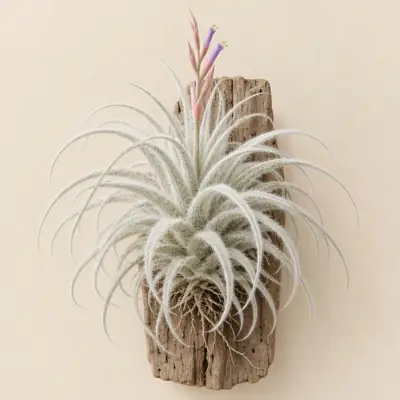
fuzzy air plant (Tillandsia tectorum)
Tillandsia tectorum is an evergreen, clumping epiphytic perennial that can be secured to a support without soil. Each rosette gradually declines after flowering and can produce offsets that continue the plant's growth.
Watch: 25 Air Plants: No Soil, Seriously
Overview
Tillandsia tectorum is an evergreen, clumping epiphytic perennial that can be secured to a support without soil. Each rosette gradually declines after flowering and can produce offsets that continue the plant's growth.
Origin and habitat
Sources differ in accounts of its native range, which is described as Ecuador and Peru. Its native environment can experience strong winds, dense fog, heavy rain, and intense sunlight after clouds move away; Tillandsia commonly grows epiphytically on surfaces such as trees, rocks, or cliffs. It is reported to grow in humid, foggy, rainy, and windy environments that also receive intense sunlight.
Characteristics
Few sources report a mature height of about 10–50 cm and a mature spread of about 10–50 cm. It is reported to grow slowly toward maturity. The leaves are densely covered with silvery-white, fuzzy trichomes; Tillandsia leaves are typically arranged in rosettes and may be linear or strap-shaped. The plant has silvery, dense trichomes.
Light
Sources differ somewhat, but bright indirect light or partial sun is described as suitable, and the silvery, densely trichomed T. tectorum can tolerate more direct light than typical air plants. Bright indirect light is recommended.
Watering
Sources differ on watering frequency, but watering is described as more frequent during hot, dry conditions, with thorough drainage and rapid drying afterward to prevent water from remaining at the base or between the leaves. Soak, then let dry. It is reported to need to dry quickly after watering.
Humidity and airflow
It is generally reported to prefer high humidity. It needs good airflow.
Temperature and dormancy
It is generally considered frost tender; keep above freezing.
Growing medium and mounting
It does not require potting medium and can be attached or tied to supports, wood, rocks, bark, or cork. It is suited to being mounted.
Feeding
It is generally reported to need little or no feeding.
Propagation
It can be propagated from seed or by separating offsets after they have grown to a specified proportion of the mother plant's size.
Common problems
Possible pests include aphids and mealybugs; Tillandsia in general may also be affected by scale insects and spider mites. Sources differ: RHS describes this species as generally free of notable disease, while general information for Tillandsia records possible sooty mold or crown rot. It is reported that water remaining in the center or between leaves after soaking can lead to rot; brown, crisp leaf tips are generally associated with insufficient water, while excessive light can also cause browning or bleaching. In cultivation it needs good airflow and rapid drying, while its native environment can experience strong winds, dense fog, heavy rain, and brief intense sunlight.
Identification
Very dense trichomes across the plant give it a silvery-white, fluffy appearance; these trichomes can scatter intense light and increase the surface available for evaporation.
Photos


Sources
- Wikipedia (en): Tillandsia tectorum — CC BY-SA 4.0 · link
- Wikipedia (es): Tillandsia tectorum — CC BY-SA 4.0 · link
- RHS Plants: Tillandsia tectorum — © RHS, facts only · link
- Rainforest Flora care guide: Tillandsia (group-level) — © Rainforest Flora, facts only · link
- NHK みんなの趣味の園芸 植物図鑑: Tillandsia (genus-level) — © NHK出版, facts only · link
- NC State Plant Toolbox: Tillandsia (genus-level) — copyright (facts only) · link