
Airplant (Tillandsia stricta)
Tillandsia stricta is an evergreen, clumping perennial; Tillandsia species typically form rosettes and often grow as epiphytes. After flowering, the mother plant gradually declines while producing offsets at the base that continue growing.
Watch: 25 Air Plants: No Soil, Seriously
Overview
Tillandsia stricta is an evergreen, clumping perennial; Tillandsia species typically form rosettes and often grow as epiphytes. After flowering, the mother plant gradually declines while producing offsets at the base that continue growing.
Origin and habitat
Sources differ on the native range: it is described as native to Central and South America, with records covering Trinidad, Guyana, Suriname, Venezuela, Brazil, Bolivia, Paraguay, Uruguay, and northeastern Argentina, while var. disticha is recorded in Paraná, Brazil. Tillandsia species are mostly epiphytes on trees but can also grow on rocks or cliffs, using their roots for anchorage while absorbing most water and nutrients through their leaves. The distribution includes warm regions of Central and South America, while the genus Tillandsia occurs from tropical to warm-temperate environments.
Characteristics
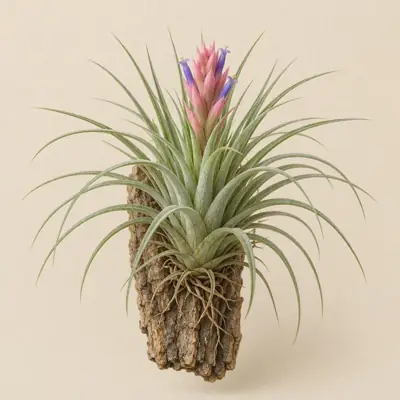
A single source reports a mature height and spread of about 10–50 cm. The leaves range from green to silvery green; Tillandsia species typically have linear or strap-shaped leaves with scale-like hairs that absorb water and nutrients. It is reported to have pink flower buds and pale purple petals.
Light
It is generally grown in partial sun; in greenhouse cultivation, bright but diffused light and good ventilation are recommended. It does well in bright indirect light.
Watering
Sources differ on watering: from spring through autumn it may be soaked in rainwater regularly and more frequently in hot, dry conditions; afterward it should drain thoroughly with good airflow so water does not remain for long periods at the leaf bases or crown. Soak, then let dry. A single source reports that the plant should dry quickly after watering.
Humidity and airflow
Tillandsia stricta needs good airflow.
Temperature and dormancy
It is generally assigned the RHS H1C hardiness rating.
Growing medium and mounting
It generally does not need potting medium and can be attached or tied to a support; the growing environment should drain well. It can be grown mounted.
Feeding
Tillandsia species are generally reported to require little or no fertilizer.
Propagation
It can be propagated from seed or by separating offsets; RHS recommends waiting until offsets are substantially developed relative to the mother plant before separating them.
Common problems
Potential pests include aphids, mealybugs, other scale insects, and, in general Tillandsia references, mites. Sources differ on disease problems: RHS considers disease generally uncommon, while general Tillandsia cultivation references report sooty mold or crown rot. Water remaining for prolonged periods at the base, crown, or between leaves after watering may cause rot; good airflow and rapid drying are recommended. It is generally recommended to grow the plant in a sheltered position; in summer it may be moved outdoors for rainwater, stronger light, and higher humidity.
Identification
Tillandsia stricta can be recognized by green to silvery green leaves, pink flower buds, and pale purple petals; it does not need ordinary potting medium and can grow attached to a support.
Photos


Sources
- Wikipedia (en): Tillandsia stricta — CC BY-SA 4.0 · link
- Wikipedia (es): Tillandsia stricta — CC BY-SA 4.0 · link
- GBIF descriptions: Catálogo de Plantas y Líquenes de Colombia — per dataset · link
- RHS Plants: Tillandsia stricta — © RHS, facts only · link
- Rainforest Flora care guide: Tillandsia (group-level) — © Rainforest Flora, facts only · link
- NHK みんなの趣味の園芸 植物図鑑: Tillandsia stricta — © NHK出版, facts only · link
- NC State Plant Toolbox: Tillandsia (genus-level) — copyright (facts only) · link