
Tillandsia seleriana (Tillandsia seleriana)
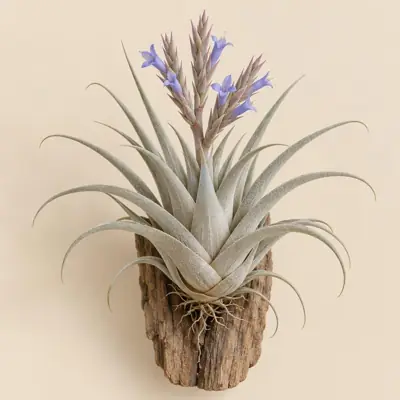
Tillandsia seleriana is reported to be an evergreen, perennial epiphyte that usually anchors to surfaces such as tree trunks and rocks, with its leaves taking up water and nutrients. It is reported to flower once when mature, after which offsets may form at the base as the parent plant gradually declines.
Watch: 25 Air Plants: No Soil, Seriously
Overview
Tillandsia seleriana is reported to be an evergreen, perennial epiphyte that usually anchors to surfaces such as tree trunks and rocks, with its leaves taking up water and nutrients. It is reported to flower once when mature, after which offsets may form at the base as the parent plant gradually declines.
Origin and habitat
Tillandsia seleriana is reported from southern Mexico through Central America, with the source further describing its range as extending from Mexico to Nicaragua. The genus Tillandsia is reported to grow epiphytically on trees or rocks and to occur across diverse environments including forests, deserts, and mountains. The genus Tillandsia is reported to span tropical to warm-temperate environments, with some species adapted to drier conditions.
Characteristics
A source reports a mature height of about 10–100 cm; sources are few. Tillandsia species are generally reported to have strap-shaped, succulent leaves with gray-silver water-absorbing scales, or trichomes, that take up water and nutrients. The genus Tillandsia is reported to produce conspicuous, often relatively long-lasting inflorescences, with flower colors in the genus including green, white, yellow, blue, purple, or pink. The source reports a particular flowering season and describes the fruit as a capsule with a particular size and fruiting period.
Light
Sources describe light requirements differently: ample light is recommended in general, with bright light indoors and bright shade away from excessively strong direct sun in summer. It is generally described as preferring bright indirect light.
Watering
Sources describe watering practices differently: regular watering while avoiding prolonged water accumulation at the base is recommended, with approaches including thoroughly wetting the plant and draining excess water while maintaining airflow so it dries quickly, or misting the entire plant indoors. It is generally recommended to soak, then let dry, with the plant drying within a relatively short period.
Humidity and airflow
It is reported to need good airflow.
Growing medium and mounting
It is generally preferred mounted.
Feeding
Sources describe feeding differently: fertilizer needs are low, and if fertilizer is used during active growth, a dilute water-soluble fertilizer may be applied at a low concentration.
Propagation
It is reported to be propagated from offsets produced after flowering, which may be separated after reaching a sufficient size relative to the parent plant. Propagation by seed is also reported, but growth is very slow.
Common problems
Reported pests include scale insects and spider mites, while mealybugs may also occur in indoor cultivation. Sooty mold and crown rot are reported as possible problems. Brown, crisp leaf tips may be associated with insufficient water, while prolonged water accumulation at the base or between leaves may cause rot; after watering, accumulated water should be drained and good airflow maintained. Tillandsia species are generally reported to tolerate heat, while cold tolerance ranges from moderate to relatively weak and tolerance of intense sunlight varies among species.
Identification
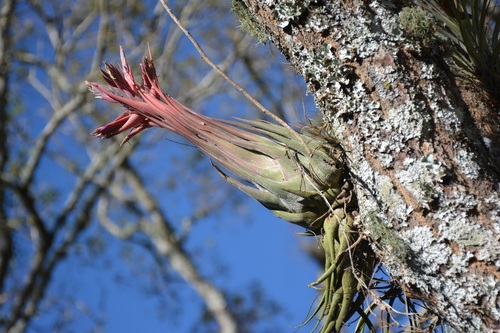
Tillandsia seleriana is reported to be an epiphytic, rosette-forming bromeliad with few roots or slender, rigid roots used mainly for anchorage, while scales on the leaves absorb water and nutrients.
Photos


Sources
- Wikipedia (en): Tillandsia seleriana — CC BY-SA 4.0 · link
- Wikipedia (es): Tillandsia seleriana — CC BY-SA 4.0 · link
- Rainforest Flora care guide: Tillandsia (group-level) — © Rainforest Flora, facts only · link
- NHK みんなの趣味の園芸 植物図鑑: Tillandsia (genus-level) — © NHK出版, facts only · link
- NC State Plant Toolbox: Tillandsia (genus-level) — copyright (facts only) · link