
Tillandsia juncea (Tillandsia juncea)
Tillandsia juncea is an evergreen, epiphytic perennial herb that can grow in clumps. It is reported to be perennial.
Watch: 25 Air Plants: No Soil, Seriously
Overview
Tillandsia juncea is an evergreen, epiphytic perennial herb that can grow in clumps. It is reported to be perennial.
Origin and habitat
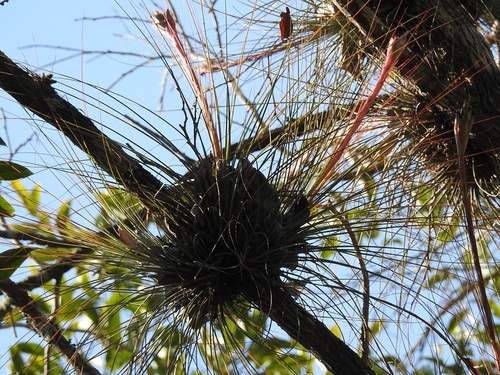
Sources differ on the native range, describing a distribution from Mexico, Central America and the West Indies into northern and tropical South America, with records from Colombia, Venezuela, Ecuador, Peru, Bolivia, eastern Brazil, Cuba, Hispaniola, Jamaica and Trinidad. It grows epiphytically in habitats including evergreen forest; Colombian records also include dry forest and Selvas del Lipa in Arauca, across both lowland and higher-elevation environments.
Characteristics
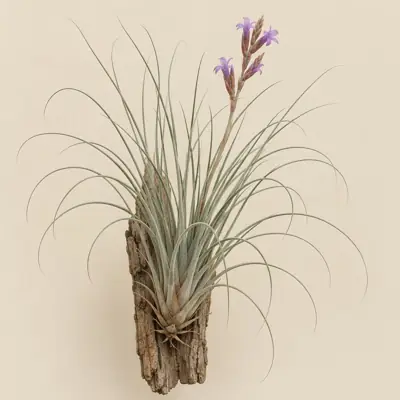
Mature plants are 20–40 cm tall; sources are few for spread, which is reported at about 10–50 cm. The leaves are long, slender, grass-like and gray-green, with a broader base tapering into an inrolled, thread-like tip and a covering of gray-white scales. The small purple flowers occur in simple or finger-like compound inflorescences, with purple flowers emerging between red bracts. Sources differ on flowering season, while the fruit is generally described as a capsule that may be present through much of the year.
Light
Tillandsia juncea generally grows in bright indirect light or partial sun; east- or west-facing positions are reported as suitable, while strong direct light should be avoided under the greenhouse conditions described by the source.
Watering
Sources differ on watering details, but describe regular soaking from spring through autumn, more frequent watering in hot, dry conditions, and avoiding prolonged water accumulation around the plant base. The general method is to soak, then let dry, with thorough drainage afterward; one source reports that the plant should dry quickly after watering.
Humidity and airflow
Tillandsia juncea is reported to need good airflow.
Temperature and dormancy
An RHS hardiness rating is reported for Tillandsia juncea.
Growing medium and mounting
Ordinary potting medium is unnecessary; Tillandsia juncea can be grown mounted on supports, wood or similar surfaces.
Feeding
General cultivation guidance for Tillandsia is reported to require little to no feeding.
Propagation
Tillandsia juncea is reported to be propagated from seed or by separating offsets after they have grown sufficiently large relative to the parent plant.
Common problems
Potential pests include aphids and mealybugs, while general Tillandsia information also records scale insects and leaf mites. Sources differ on disease concerns: RHS describes this species as generally having few diseases, while general Tillandsia information records sooty mold. Standing water and insufficient drying can lead to crown or basal rot, so good drainage and airflow are needed after watering. One source recommends a sheltered growing position and reports that plants can be moved outdoors in summer to benefit from rainwater, stronger light and humidity.
Identification
Tillandsia juncea has no conspicuous stem and bears long, very slender gray-green leaves with thread-like tips; mature plants can produce small purple flowers with red bracts.
Photos



Sources
- Wikipedia (en): Tillandsia juncea — CC BY-SA 4.0 · link
- Wikipedia (es): Tillandsia juncea — CC BY-SA 4.0 · link
- GBIF descriptions: Catálogo de Plantas y Líquenes de Colombia; Plantas vasculares que se han reportado en los bosques s — per dataset · link
- RHS Plants: Tillandsia juncea — © RHS, facts only · link
- Rainforest Flora care guide: Tillandsia (group-level) — © Rainforest Flora, facts only · link
- NHK みんなの趣味の園芸 植物図鑑: Tillandsia (genus-level) — © NHK出版, facts only · link
- NC State Plant Toolbox: Tillandsia (genus-level) — copyright (facts only) · link