
Blushing Bride (Tillandsia ionantha)
Tillandsia ionantha is an evergreen perennial herb, primarily an epiphyte but also able to grow on rocks; it is usually stemless or short-stemmed, forms a rosette of leaves, and can develop into clumps through offsets.
Watch: 25 Air Plants: No Soil, Seriously
Overview
Tillandsia ionantha is an evergreen perennial herb, primarily an epiphyte but also able to grow on rocks; it is usually stemless or short-stemmed, forms a rosette of leaves, and can develop into clumps through offsets.
Origin and habitat
Tillandsia ionantha is native to Mexico and Central America, but sources differ on whether its range extends south to Nicaragua or Costa Rica. In its natural habitat it grows mainly as an epiphyte on supports and can also grow on rocks, with roots serving chiefly for anchorage rather than penetrating soil.
Characteristics
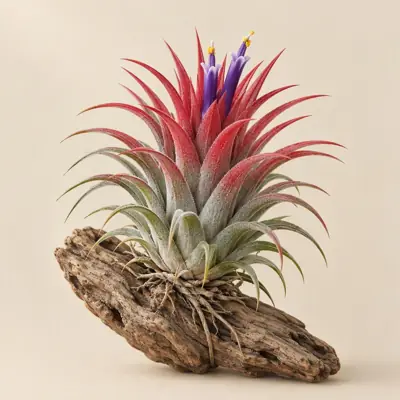
Sources differ on mature height, with the limited evidence suggesting about 6–8 cm; mature spread is reported from a single source at about 10–50 cm. The leaves are narrow-triangular to grass-like and densely covered with silvery-gray to silvery-white scales; typical plants have green leaves, with upper or outer leaves becoming bright red near flowering, while 'Fuego' can become intensely fiery red under ample light. The plant has silvery, dense trichomes, and its sessile flowers are mainly purple to blue-purple, emerging among the leaves on a very short inflorescence, though sources differ in their descriptions of flower number. The fruit is reported to be a capsule, with one source describing it as cylindrical.
Light
Provide bright indirect light; RHS recommends partial sun and avoiding excessively strong direct exposure, while 'Fuego' develops a more vivid fiery-red color with ample light.
Watering
From spring through autumn, soak in rainwater regularly and increase the frequency in hot, dry conditions; after watering or soaking, drain thoroughly and let the plant dry so water does not remain between the leaves. A single source reports that the plant should dry promptly after watering.
Temperature and dormancy
The plant is reported by a single source as having an H1C hardiness rating.
Growing medium and mounting
Tillandsia ionantha does not require potting soil and can be mounted on supports such as wood, ceramic, or glass, or kept in a container without medium.
Feeding
A single source recommends diluted liquid fertilizer during the growing season, at a concentration below the usual recommendation.
Propagation
Propagation can be by seed or by separating offsets; RHS recommends waiting until offsets have reached a substantial proportion of the parent plant's size before removing them.
Common problems
Pests are generally uncommon, though aphids and mealybugs may occur, and diseases are generally uncommon. After watering, remove excess water remaining between the leaves and allow the plant to dry thoroughly; the growing environment requires good airflow.
Identification
Tillandsia ionantha is distinguished by conspicuous silvery-gray scales on the leaves, upper leaves that turn red before flowering, and blue-purple to purple flowers on short inflorescences; 'Fuego' is characterized by a vivid fiery-red color under ample sunlight.
Photos


Sources
- Wikipedia (en): Tillandsia ionantha — CC BY-SA 4.0 · link
- 維基百科:Tillandsia ionantha — CC BY-SA 4.0 · link
- Wikipedia (ja): チランジア・イオナンタ — CC BY-SA 4.0 · link
- Wikipedia (fr): Tillandsia ionantha — CC BY-SA 4.0 · link
- Wikipedia (es): Tillandsia ionantha — CC BY-SA 4.0 · link
- NC State Plant Toolbox: Tillandsia ionantha — copyright (facts only) · link
- RHS Plants: Tillandsia ionantha — © RHS, facts only · link
- USDA PLANTS Database: Tillandsia ionantha — Public domain (US Government work) · link
- Rainforest Flora care guide: Tillandsia (group-level) — © Rainforest Flora, facts only · link
- NHK みんなの趣味の園芸 植物図鑑: Tillandsia ionantha — © NHK出版, facts only · link