
Wallisia cyanea (Tillandsia cyanea)
Tillandsia cyanea is an evergreen, clumping epiphytic herb whose leaves form a rosette. It is perennial; an individual rosette gradually declines after flowering, while basal offsets can continue the plant's growth.
Watch: 25 Air Plants: No Soil, Seriously
Overview
Tillandsia cyanea is an evergreen, clumping epiphytic herb whose leaves form a rosette. It is perennial; an individual rosette gradually declines after flowering, while basal offsets can continue the plant's growth.
Origin and habitat
Sources differ on its native range: it is chiefly recorded as native to Ecuador, some accounts extend its distribution to Colombia, while RHS lists Ecuador and Peru. It is reported to occur as an epiphyte in humid, rainy tropical forest, including high in tall trees, with different varieties recorded from elevated habitats. Its environment is generally described as tropical, humid, rainy forest.
Characteristics
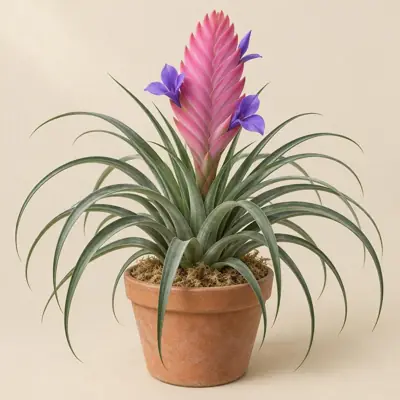
Mature plants range from 10–50 cm in height and 10–50 cm in spread. It is reported to have no obvious stem or only a very short one, with numerous linear to narrowly triangular, finely pointed leaves forming a rosette; the leaves arch backward, are dark gray-green with fine scales, and may show purple-brown longitudinal markings at the base. The inflorescence is reported to be flattened and paddle-like or feather-like, with pink to red, leathery, overlapping bracts from which purple to deep-purple flowers emerge in sequence. Flowering is reported in spring and autumn.
Light
Bright indirect light is supported across sources. It is generally reported to suit bright, filtered light to partial sun, with a sheltered east- or west-facing position.
Watering
From spring through autumn, the plant can be thoroughly wetted with rainwater at intervals, then drained and allowed to dry; prolonged water retention in the center should be avoided and good airflow maintained. The watering method is to soak, then let dry. It is reported to require drying after watering.
Humidity and airflow
Tillandsia cyanea needs good airflow.
Temperature and dormancy
With few sources, the reported minimum is about 7 °C. It is generally assigned RHS H1C and described as frost tender; keep above freezing.
Growing medium and mounting
Sources describe this differently: the plant can be fixed to a support without ordinary potting medium, while Tillandsia cyanea can also be grown in a pot using sphagnum moss or coconut-husk-type medium. It is generally described as mounted.
Feeding
Feeding needs are reported to be low; potted Tillandsia cyanea may receive slow-release fertilizer periodically from spring through autumn.
Propagation
It can be propagated by seed or by separating offsets; sources recommend waiting until offsets are sufficiently developed before separation, using either their size relative to the parent or their leaf development as the criterion.
Common problems
Possible pests include aphids and mealybugs, while general Tillandsia information also records scale insects and leaf mites. RHS considers diseases generally uncommon, while general Tillandsia cultivation information records sooty mold and center rot as possible problems. Prolonged water retention in the center or between leaves may cause rot, so excess water should be removed after watering and airflow maintained. A sheltered position is suitable, and in summer the plant can be moved outdoors to benefit from rainwater, stronger light, and humidity.
Identification
It is reported to be distinguished by a conspicuous flattened, paddle-shaped pink to red inflorescence with overlapping bracts, from which purple flowers open successively, together with a rosette of outward-curving leaves.
Photos


Sources
- Wikipedia (en): Wallisia cyanea — CC BY-SA 4.0 · link
- Wikipedia (ja): ハナアナナス — CC BY-SA 4.0 · link
- Wikipedia (fr): Tillandsia cyanea — CC BY-SA 4.0 · link
- Wikipedia (es): Tillandsia cyanea — CC BY-SA 4.0 · link
- RHS Plants: Tillandsia cyanea — © RHS, facts only · link
- Rainforest Flora care guide: Tillandsia (group-level) — © Rainforest Flora, facts only · link
- NHK みんなの趣味の園芸 植物図鑑: Tillandsia (genus-level) — © NHK出版, facts only · link