
Medusa's head (Tillandsia caput-medusae)
Tillandsia caput-medusae is an evergreen, clumping epiphyte with leaves forming a rosette from a swollen pseudobulb-like base. It is perennial; after flowering, the mother plant gradually ages while producing offsets that continue growth.
Watch: 25 Air Plants: No Soil, Seriously
Overview
Tillandsia caput-medusae is an evergreen, clumping epiphyte with leaves forming a rosette from a swollen pseudobulb-like base. It is perennial; after flowering, the mother plant gradually ages while producing offsets that continue growth.
Origin and habitat
It is native from Mexico into Central America, with more specific accounts extending its native range from Mexico to Costa Rica. It is an epiphyte; Tillandsia species typically attach to trees, rocks, or other surfaces, with roots used mainly for anchorage. The genus Tillandsia spans tropical to warm-temperate environments, while this species is native to Mexico and Central America.
Characteristics
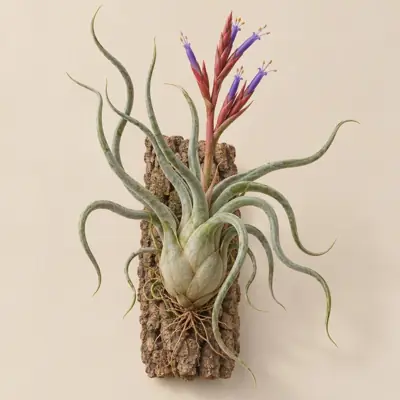
A single source reports a mature height and spread of about 10–50 cm; sources for these measurements are few. The leaves are reported to be thick, narrow, strap-like, grooved, and conspicuously curved, curled, or twisted, with pointed tips and gray to greenish-white hairlike scales or trichomes; the trichomes are described as silvery, dense trichomes. The flowers are reported to have vivid purple to violet petals with stamens projecting beyond them, while the inflorescence is often red and its spikes may be solitary or arranged in a palmate cluster; greenhouse-grown plants are reported to flower from spring into early summer. The fruit is reported to be a slender, cylindrical capsule.
Light
Tillandsia caput-medusae is suited to bright indirect light, extending to partially shaded conditions.
Watering
Sources differ on the watering details: from spring through autumn, soaking in rainwater is described, with greater frequency in hot, dry conditions, followed by thorough draining and drying so water does not remain at the base or between leaves. The general method is to soak, then let dry. A single source reports that the plant should dry within a short period.
Humidity and airflow
It is reported to need good airflow.
Temperature and dormancy
A single source reports an RHS hardiness classification for this species.
Growing medium and mounting
It does not require ordinary potting soil and can be grown attached to a support, with a preference for being mounted.
Feeding
Tillandsia species are generally reported to require almost no feeding.
Propagation
It can be propagated from seed or by separating offsets formed after flowering; the RHS recommends waiting until offsets have reached a substantial proportion of the mother plant's size before separating them.
Common problems
This species may be affected by aphids and mealybugs, while scale insects and spider mites are also recorded for Tillandsia at the genus level. Sources differ on disease problems: the RHS describes this species as generally free of conspicuous disease, while genus-level Tillandsia information records sooty mold and crown rot among potential problems. A source reports that water remaining for too long at the base or between the leaves after watering may lead to rot, while good airflow and rapid drying can reduce the risk. A source reports that a sheltered, well-ventilated position is suitable and that the plant can be moved outdoors in summer to receive rainwater, stronger light, and ambient humidity.
Identification
The overlapping, swollen leaf sheaths are reported to form a flask-like pseudobulb from which numerous narrow, irregularly curved and curled leaves emerge, resembling the snake-like hair of the mythological Medusa.
Photos


Sources
- Wikipedia (en): Tillandsia caput-medusae — CC BY-SA 4.0 · link
- Wikipedia (ja): チランジア・カプトメドゥーサエ — CC BY-SA 4.0 · link
- Wikipedia (es): Tillandsia caput-medusae — CC BY-SA 4.0 · link
- RHS Plants: Tillandsia caput-medusae — © RHS, facts only · link
- Rainforest Flora care guide: Tillandsia (group-level) — © Rainforest Flora, facts only · link
- NHK みんなの趣味の園芸 植物図鑑: Tillandsia (genus-level) — © NHK出版, facts only · link
- NC State Plant Toolbox: Tillandsia (genus-level) — copyright (facts only) · link