
Tillandsia brachycaulos (Tillandsia brachycaulos)
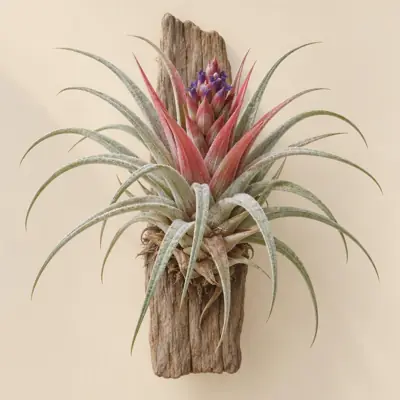
Tillandsia brachycaulos is reported to be an evergreen epiphytic herb that usually grows as a rosette, with roots mainly serving for anchorage while scales on the leaves absorb most water and nutrients. It is reported to be perennial; mature plants can produce offsets from the base after flowering, after which the mother plant gradually declines.
Watch: 25 Air Plants: No Soil, Seriously
Overview
Tillandsia brachycaulos is reported to be an evergreen epiphytic herb that usually grows as a rosette, with roots mainly serving for anchorage while scales on the leaves absorb most water and nutrients. It is reported to be perennial; mature plants can produce offsets from the base after flowering, after which the mother plant gradually declines.
Origin and habitat
Sources differ on its native range, describing it either as Mexico, Central America, and Venezuela or as extending from Mexico to Panama. The genus Tillandsia is reported to grow as an epiphyte on trees or attached to surfaces such as rocks and cliffs, across varied environments including forests, deserts, and mountains. The genus Tillandsia spans tropical to warm-temperate environments, while records for this species' native range extend across Mexico, Central America, and Venezuela.
Characteristics
A source reports a mature height of about 10–100 cm; sources are few. The genus Tillandsia is reported to usually have strap-shaped, slightly succulent leaves with scales or hair-like structures that absorb water and nutrients; some species appear silvery gray and become greener when wet. Mature plants in the genus Tillandsia are reported to flower either directly among the leaves or in an inflorescence, with flower colors in the genus including green, white, yellow, blue, purple, and pink. Tillandsia brachycaulos is reported to have a particular flowering period and to produce capsules during a recorded fruiting period.
Light
Provide ample light; indoors, a bright position can be used, but sources differ on direct-light recommendations, with a more conservative approach during the warmer season being bright shade while avoiding intense exposure. Bright indirect light is generally recommended.
Watering
Water regularly and wet the whole plant thoroughly; after soaking or rinsing, drain water from the leaf bases, maintain good airflow, and allow the plant to dry relatively quickly, while sources differ on whether misting alone is sufficient. A generally reported method is to soak, then let dry. The plant is reported to need to dry within a relatively short period after watering.
Humidity and airflow
Tillandsia brachycaulos is reported to need good airflow.
Growing medium and mounting
For typical epiphytic cultivation, soil is generally reported to be unnecessary; the plant can be secured to wood, bark, cork, rock, or another suitable support. It is generally grown mounted.
Feeding
Fertilizer needs are low and light feeding can be used, but sources differ: one recommends diluted water-soluble fertilizer during active growth, while another considers most Tillandsia to need little or no fertilizer.
Propagation
It is reported to be propagated from offsets formed after flowering, which can be separated from the mother plant after they have grown; propagation from seed is also possible but growth is very slow.
Common problems
Reported pests include scale insects and mites, while mealybugs may also occur in typical indoor cultivation. Sooty mold and crown rot are reported problems. Brown, crisp leaf tips may be associated with insufficient water, while water remaining in the leaf bases or rosette center for too long may cause rot; excessively strong light may cause browning or bleaching, whereas insufficient light may lead to weak or elongated growth. It is reported to tolerate heat well but to have only moderate to relatively weak cold tolerance.
Identification
Tillandsia brachycaulos is reported to grow without relying on soil, with roots used mainly for anchorage and specialized scales on the leaves absorbing water and nutrients.
Photos


Sources
- Wikipedia (en): Tillandsia brachycaulos — CC BY-SA 4.0 · link
- Wikipedia (es): Tillandsia brachycaulos — CC BY-SA 4.0 · link
- Rainforest Flora care guide: Tillandsia (group-level) — © Rainforest Flora, facts only · link
- NHK みんなの趣味の園芸 植物図鑑: Tillandsia (genus-level) — © NHK出版, facts only · link
- NC State Plant Toolbox: Tillandsia (genus-level) — copyright (facts only) · link