
pinwheelflower (Tabernaemontana divaricata)
Tabernaemontana divaricata is an evergreen shrub to small tree. It is reported to be perennial.
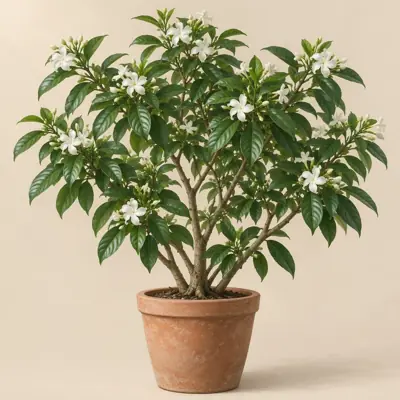
Overview
Tabernaemontana divaricata is an evergreen shrub to small tree. It is reported to be perennial.
Origin and habitat
Sources differ on the description of its native range: it is associated with tropical to subtropical parts of Asia, including India, Myanmar, Thailand, and southern China, while broader accounts describe it as native to South Asia, Southeast Asia, and China. It occurs in montane shrubland and open woodland, including open woodland in hilly areas. It is suited to tropical and subtropical environments at low to middle elevations and can be grown indoors or in a greenhouse in areas where it is not cold hardy.
Characteristics
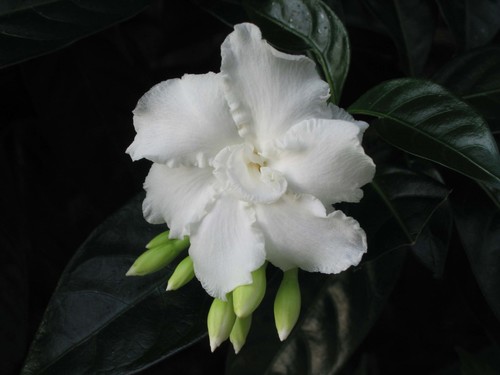
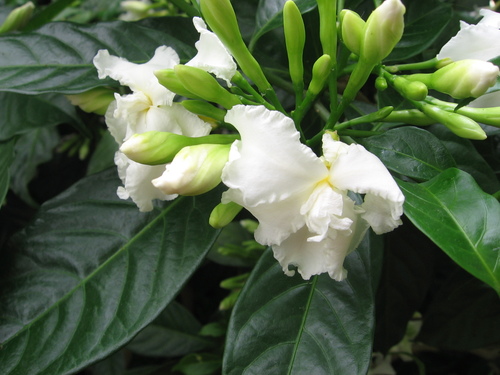
Sources differ on mature height, reporting about 50–500 cm. A single source reports a mature spread of about 152.4–304.8 cm, so sources are few. The leaves are large, glossy, dark green, and oblanceolate, and damaged branches and leaves exude white latex. The fragrant flowers are white to nearly white and commonly form small terminal cymes; single-flowered forms have a pinwheel-like appearance, while forms with additional petals or double flowers are also cultivated, and flowering occurs mainly from spring through autumn but may be sporadic or continuous throughout the year under suitable conditions.
Light
It grows in full sun to partial sun; indoor container plants can be kept in a bright location, and another recommendation is a position with morning sun and afternoon shade.
Watering
Water regularly and keep the growing medium moderately moist without waterlogging; water can be added when the surface has dried slightly, with particular attention to moisture in summer.
Humidity and airflow
It is reported to prefer high humidity.
Temperature and dormancy
It is generally frost tender; keep above freezing.
Growing medium and mounting
It is suited to organic-rich loam or sandy loam and prefers a fertile, moist but well-drained growing medium; another source indicates that the soil should not be excessively alkaline.
Feeding
To promote growth, a slow-release fertilizer is reported to be suitable from spring through autumn.
Propagation
It can be propagated by cuttings, air layering, or seed; cuttings that exude white latex can first be allowed to dry in the shade before planting, while air layering is described using ring-barked established branches in spring.
Common problems
A source reports vigorous growth with relatively few pest problems and relatively little disease, without identifying a specific common disease. Hot, dry conditions may impair growth, while the thin petals can be damaged by rain and lose ornamental quality; the growing medium should not become waterlogged. It is sensitive to frost and severe cold and should be protected from freezing; severe cold may cause leaf drop and dormancy, and the flowers are also sensitive to heavy rain.
Identification
The fragrant white flowers have a pinwheel-like appearance, and broken branches and leaves exude white latex; these features can help distinguish Tabernaemontana divaricata from similar-looking gardenias.
Photos


Sources
- Wikipedia (en): Tabernaemontana divaricata — CC BY-SA 4.0 · link
- 維基百科:山马茶 — CC BY-SA 4.0 · link
- GBIF descriptions: Lista de especies de plantas exóticas y trasplantadas de Colombia; Catálogo de Plantas y Líquenes de — per dataset · link
- Wikipedia (pt): Tabernaemontana divaricata — CC BY-SA 4.0 · link
- 農業知識入口網 植物圖鑑: Tabernaemontana divaricata — © MOA, facts only · link
- Useful Tropical/Temperate Plants: Tabernaemontana divaricata — CC BY-NC-SA 3.0 (facts only) · link
- USDA PLANTS Database: Tabernaemontana divaricata — Public domain (US Government work) · link
- Top Tropicals catalog: Tabernaemontana divaricata — © Top Tropicals LLC (facts only) · link