
syzygium (Syzygium samarangense)
Syzygium samarangense is an evergreen tropical tree with a relatively short trunk and a broad, open crown, often branching from near the base.
Overview
Syzygium samarangense is an evergreen tropical tree with a relatively short trunk and a broad, open crown, often branching from near the base.
Origin and habitat
Sources differ on its native range: it is native to tropical Southeast Asia, centered on the Malay Peninsula and Greater Sunda Islands, while some accounts also include the Andaman and Nicobar Islands. It is reported from moist lowland tropical environments, including coastal forests and scrub behind beaches, and is also commonly planted along streams or ponds. It is associated with tropical to subtropical, moist, frost-free climates, requires a reliable water supply, and is suited to warm lowland environments.
Characteristics
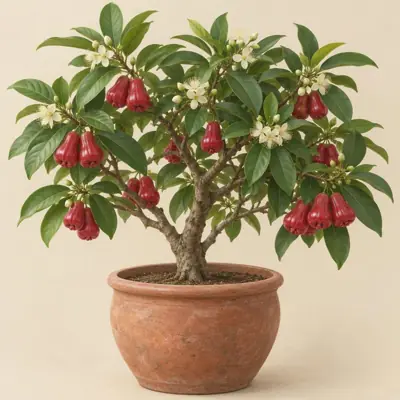
Sources differ on mature height, giving a range of about 500–1200 cm. It is reported to grow rapidly and to have evergreen, simple leaves that are elliptic to oblong, with rounded to slightly heart-shaped bases and an aromatic scent when crushed. The flowers are reported to be white to yellowish white, with petals and numerous stamens; flower clusters may occur at branch tips or near leaf axils, and flowers may also appear elsewhere on the branches and trunk. Sources differ on the flowering period in Asia, placing it generally in spring; the fruit is typically bell-shaped to pear-shaped or conical, with mature colors ranging from white, pale green, and green to red, purplish red, deep purple, or nearly black, and sources describe considerable variation among cultivated forms in fruit shape and the presence of seeds.
Light
It is reported to grow best in a position with abundant sunlight, though it can also grow in light shade.
Watering
It requires a steady, ample water supply and does not tolerate drought; it can grow beside water and has relatively strong tolerance of waterlogging, although another source favors well-drained soil.
Temperature and dormancy
With few sources, the reported minimum temperature is about 0 °C and the reported maximum is about 33 °C.
Growing medium and mounting
It tolerates a broad range of soils, with deep, fertile, moist, well-drained soil preferred, and can adapt from slightly acidic to slightly alkaline conditions; sources differ in the detailed soil preferences.
Propagation
It is reported to be propagated by cuttings, air layering, or seed; cuttings may be rooted under shaded, moisture-retaining conditions.
Common problems
Reported pests include scarab beetles, scale insects, tussock moths, aphids, bagworms, thrips, and gall midges. Reported diseases include anthracnose and fruit rot. Sudden rain may cause fruit cracking; the thin fruit skin is easily damaged, and some sources report that insect larvae readily invade the fruit interior. It is sensitive to cold and frost, with flower buds, young fruit, and fruit nearing harvest susceptible to cold damage; strong winds or typhoons during fruiting can also cause branches to break.
Identification
The fruit is reported to be often bell-shaped with a waxy-looking sheen and fleshy sepals retained at the end; mature trees bear abundant fruit, and flowers and fruit may occur directly on branch or trunk surfaces.
Photos


Sources
- Wikipedia (en): Syzygium samarangense — CC BY-SA 4.0 · link
- 維基百科:蓮霧 — CC BY-SA 4.0 · link
- Wikipedia (ja): レンブ — CC BY-SA 4.0 · link
- Wikipedia (de): Javaapfel — CC BY-SA 4.0 · link
- Wikipedia (fr): Jamalac — CC BY-SA 4.0 · link
- Wikipedia (es): Syzygium samarangense — CC BY-SA 4.0 · link
- TaiCOL 臺灣物種名錄: Syzygium samarangense — CC BY 4.0 · link
- Useful Tropical/Temperate Plants: Syzygium samarangense — CC BY-NC-SA 3.0 (facts only) · link