
Common Lilac (Syringa vulgaris)
Syringa vulgaris is a perennial deciduous woody plant that grows as a large shrub or multi-stemmed small tree, often producing shoots from the base or roots and forming clumps.
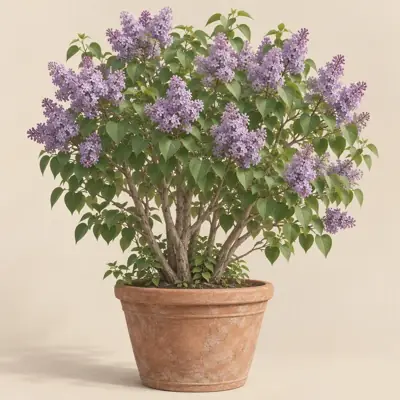
Overview
Syringa vulgaris is a perennial deciduous woody plant that grows as a large shrub or multi-stemmed small tree, often producing shoots from the base or roots and forming clumps.
Origin and habitat
Sources differ on its native range, describing southeastern Europe centered on the Balkan Peninsula, including Albania, the former Yugoslav region, North Macedonia, Serbia, Bulgaria, Greece, and Romania; it is also cultivated or naturalized in many other parts of Europe, Asia, and North America. In its native range it occurs on rocky hills and in scrub, while as an introduced plant it can also occur along woodland edges, in grassland, hedges, woodland, on rock faces, and in gardens and parks. It is suited to temperate climates with cold winters, and its flower buds require a prolonged period of winter cold to mature.
Characteristics
Sources differ on mature height, which is about 400–800 cm, while a single source reports a mature spread of about 400–800 cm. Growth is moderate, and the deciduous simple leaves are usually opposite, occasionally occurring in whorls, with ovate to heart-shaped or nearly triangular-heart-shaped forms, entire margins, pointed to shortly pointed tips, and green to slightly gray-green coloration. The distinctly fragrant flowers form dense terminal panicles; the corolla is tubular and usually lobed, with typical colors ranging from pale lilac to reddish purple and cultivated forms also including white and pink. Sources differ in describing flowering from spring into early summer; they also differ in accounts of the fruit, which is a brown, dry capsule that splits at maturity to release winged seeds.
Light
Syringa vulgaris grows in full sun and is suited to a well-lit position.
Watering
The soil should be moist but well drained; poorly drained soil is unsuitable.
Growing medium and mounting
It can adapt to chalk, clay, loam, and sandy soils provided they are well drained, preferring neutral to alkaline soil and adapting less well to highly acidic soil.
Propagation
It is reported to be propagated from softwood cuttings in summer.
Common problems
Potential pests or feeding animals include caterpillars, scale insects, lilac clearwing or stem-boring pests, lilac leaf miners, privet thrips, and pigeons or doves. Reported diseases include lilac blight, honey fungus disease, Phytophthora-related diseases, powdery mildew, and bacterial canker caused by Pseudomonas syringae. Poorly drained or highly acidic soil can hinder growth, and plants also readily produce suckers from the base. It tolerates cold, but late frost can sometimes kill flower buds, so a more sheltered position is suitable.
Identification
Syringa vulgaris is a large, clump-forming deciduous shrub to small tree that readily produces suckers from the base or roots, with opposite heart-shaped to ovate leaves and fragrant, dense terminal panicles of purple to pale lilac flowers.
Photos


Sources
- Wikipedia (en): Syringa vulgaris — CC BY-SA 4.0 · link
- 維基百科:欧丁香 — CC BY-SA 4.0 · link
- Wikipedia (ja): ライラック — CC BY-SA 4.0 · link
- Wikipedia (de): Gemeiner Flieder — CC BY-SA 4.0 · link
- Wikipedia (fr): Syringa vulgaris — CC BY-SA 4.0 · link
- Wikipedia (es): Syringa vulgaris — CC BY-SA 4.0 · link
- GBIF descriptions: Manual of the Alien Plants of Belgium; Checklist of introduced taxa in Cyprus; Database of Vascular — per dataset · link
- NC State Plant Toolbox: Syringa vulgaris — copyright (facts only) · link
- Useful Tropical/Temperate Plants: Syringa vulgaris — CC BY-NC-SA 3.0 (facts only) · link
- RHS Plants: Syringa vulgaris — © RHS, facts only · link
- USDA PLANTS Database: Syringa vulgaris — Public domain (US Government work) · link